

Table of Contents
- Why Fitted Sheets Slip and What to Look For
- Best Non Slip Fitted Sheets 2026: Top Picks
- How to Keep Fitted Sheets from Popping Off
- Best Deep-Pocket Sheets 2026 for Tall Mattresses
- Best Sheet Suspenders for Mattresses: Mechanical Fixes
- Matching Sheets to Your Mattress Type and Sleep Style
- Conclusion
- Frequently Asked Questions
Last Updated: September 14, 2026
Why Fitted Sheets Slip and What to Look For
A fitted sheet stays put when three forces work together: elastic tension at the corners, enough pocket depth to clear the mattress, and friction between fabric and mattress surface. Remove any one and you'll wake up tangled in a loose corner.

This Betterhouse guide breaks down why sheets fail, which materials grip best, and how to choose non slip fitted sheets. The short answer: elastic quality matters more than thread count, and pocket depth must match mattress height within a centimeter or two.
Elastic Quality and Corner Tension
Corner tension is the single biggest determinant of whether a fitted sheet stays put. Cheap sheets use thin hem elastic; better ones use wide, reinforced elastic fully encased at each corner.
Thin elastic loses stretch after 20-30 wash cycles; wide elasticized corners hold tension far longer. If the band is under 1 cm wide and feels flimsy, expect failure within a year.
Pocket Depth and Mattress Height
Pocket depth is the measurement from the seam to the bottom edge of the fitted sheet. A 25 cm pocket on a 30 cm mattress will pop off every time.
Standard mattresses run 20-25 cm; deep mattresses and those with toppers run 30-40 cm (How Thick Should a Mattress Be?). Measure before buying, then add 2-3 cm of buffer for shrinkage. A 40 cm wall, like the Ramesses Charcoal Pebble Wash set's, handles most deep mattresses and toppers without strain.
Best Non Slip Fitted Sheets 2026: Top Picks
The best non slip fitted sheets 2026 combine wide elasticized corners, correct pocket depth, and friction-creating fabric. Here are the picks worth considering.
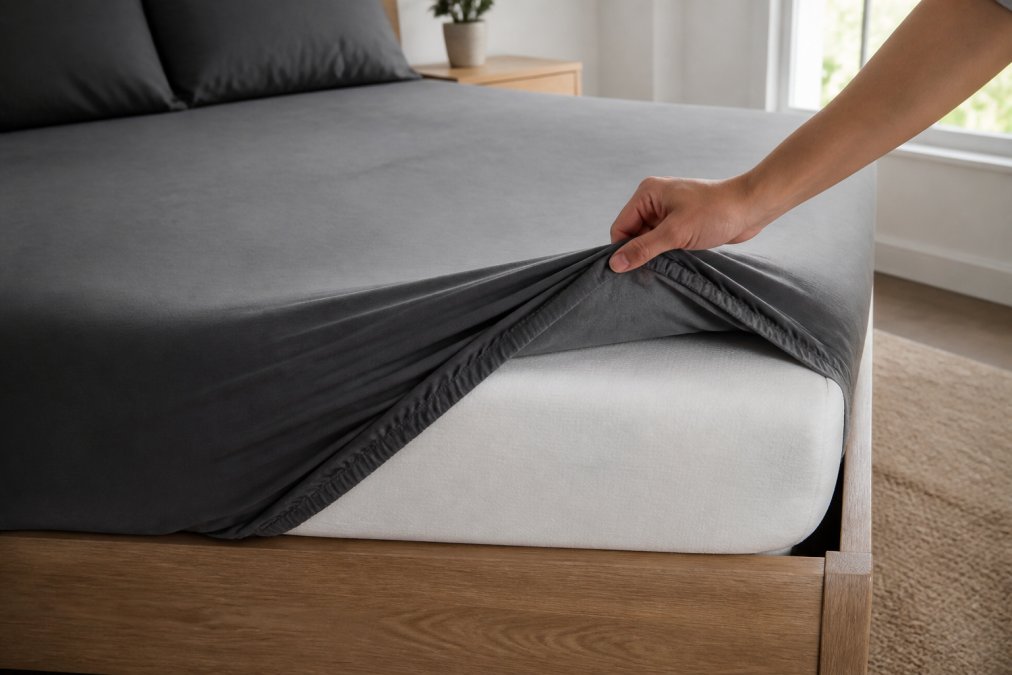
Luxurious Milk Fleece Queen Fitted Sheet - Cozy Grey
Our top pick for grip and warmth. The Milk Fleece Fitted Sheet fits Queen mattresses 25-35 cm high, 147-157 cm wide, and 198-208 cm long. Its polyester fleece creates real friction, resisting sliding far better than slick cotton sateen.
At $100.65, it costs more than the flannel options below, but the corner tension holds up wash after wash. Machine washable, and the grey suits almost any bedroom.
Pros: Excellent grip, warm for cold sleepers, easy care Cons: Polyester traps heat, so it's a poor fit for hot sleepers
Ramesses 1500TC Elite Egyptian Cotton Sateen Fitted Sheet Combo Set
For sleepers who want a smooth hand-feel without the slip, this Ramesses set pairs a 1500 thread count Egyptian cotton sateen weave with a 40 cm fitted wall that locks onto taller mattresses. The sateen finish is cool in summer, warm in winter, and tumble dries with minimal ironing.
At $80.27, it's the middle option on price. The tradeoff: sateen is smoother than percale, so it has less natural friction, and on a shallow mattress the 40 cm wall may bunch slightly.
Pros: 1500 TC Egyptian cotton, 40 cm wall, easy care Cons: Sateen finish offers less grip than textured weaves
Ramesses Charcoal Pebble Wash Linen Look Alternative Sheet Set
The best budget pick. This Ramesses set includes a fitted sheet with a 40 cm wall, a flat sheet, and pillowcases for $61.83. The pebble-wash microfiber resists pilling, holds temperature well, and its linen-look texture adds friction that smooth weaves lack.
For renters and first-apartment setups, it's the smart buy: a full set that undercuts the single fitted sheet above, with the same 40 cm depth.
Pros: Full set, 40 cm wall, resists pilling, temperature moderating Cons: Microfiber, not natural fiber, so breathability is average
Turkish Cotton Flannel Sheet Sets for Cold-Weather Grip
Flannel is the sleeper hit for slip resistance. The double-brushed surface on these Turkish cotton flannel sets creates more friction than any sateen or percale, so cold-weather sleepers report fewer popped corners. Betterhouse carries several collections at $59.99, including the Kids' Christmas Collection, the Whittaker Collection, the Lakeview Collection, the Nordic Collection, the Boulder Collection, the Stratton Collection, and the Belle Collection.
Natural cotton fibers stay breathable without overheating, and the fabric softens with each wash while holding its shape. For winter, flannel is the practical choice.
Pros: Maximum friction, breathable cotton, softens over time Cons: Too warm for summer, heavier to launder
How to Keep Fitted Sheets from Popping Off
Learning how to keep fitted sheets from popping off comes down to four fixes, ranked easiest to most involved:
- Measure before you buy. Match pocket depth to mattress height plus a 2-3 cm buffer.
- Wash cold, dry low. Heat is the enemy of elastic.
- Add corner grippers. Small elastic straps that clip under the mattress and hold corners down.
- Use sheet suspenders. Adjustable straps that pull all four corners toward center.
The first two cost nothing and solve most cases. The last two are mechanical fixes for sheets you already own.
Best Deep-Pocket Sheets 2026 for Tall Mattresses
The best deep-pocket sheets 2026 have a 40 cm or deeper wall and wide elasticized corners. Tall mattresses, memory foam beds, and topper setups need that depth, or the sheet rides up all night.
Both Ramesses sets above hit the 40 cm mark, covering most deep mattresses and toppers; the Milk Fleece Queen fits up to 35 cm. If your setup exceeds 40 cm, add a topper strap or sheet suspenders rather than sizing up, since oversized sheets bunch and slip.
Best Sheet Suspenders for Mattresses: Mechanical Fixes
The best sheet suspenders for mattresses are adjustable elastic straps with metal or heavy-duty plastic clips that grip the sheet corners and pull them diagonally under the mattress. They cost a fraction of a new sheet set and revive sheets whose elastic has given out.

Why Elastic Fails Before the Fabric Does
Fitted sheet elastic is a rubber core wrapped in fabric or braided cord. Every wash, dry cycle, and night of stretching works that core toward its elastic limit. Once it passes, it doesn't snap back, it stays stretched. The sheet still fits, but no longer pulls tight, and a loose sheet slides.
A common pattern: a sheet feels fine for 12-18 months, then starts popping corners in year two. The fabric is usually intact; the elastic is the failure point. High-heat drying is the fastest way to kill elastic, which is why quality sheets say tumble dry low or line dry.
Most buying guides rank sheets by thread count and weave, but what determines whether a sheet stays on is the elastic's ability to hold tension after 50, 100, or 200 wash cycles, a number almost no brand publishes. The practical move: buy wide, fully encased corner elastic, then add suspenders as insurance once it relaxes.
What to Look For in Sheet Suspenders
Three features separate suspenders that last from suspenders that don't:
- Elastic width. Look for 2 cm or wider. Thin elastic (under 1 cm) stretches out within months and defeats the purpose.
- Clip design. Clips with teeth grip the fabric and hold. Smooth-jaw clips slip off the sheet corner, especially on sateen and microfiber.
- Adjustability. Straps should have a buckle or slider so you can tension them to your mattress depth. Fixed-length straps either can't reach a deep mattress or over-stretch on a shallow one.
A set of four corner straps typically outlasts the sheet it's holding, because the straps are only under tension when the bed is made, not every night.
Corner Grippers vs. Full Suspenders
Two mechanical approaches solve different problems:
- Corner grippers are short elastic bands that clip to the sheet corner and hook under the mattress. They're fast to install and ideal when only one or two corners keep popping.
- Full suspenders are longer straps that run diagonally under the mattress and connect all four corners, pulling them toward center. They apply even tension across the whole sheet and are the better choice for a sheet whose elastic has failed uniformly.
For mattresses with a topper, suspenders are often the only reliable fix, since no standard fitted sheet clears both without strain. Run the straps under the topper, not the mattress, so tension holds the sheet against the topper surface rather than fighting full mattress depth.
When Mechanical Fixes Aren't Worth It
Suspenders and grippers make sense when the fabric is still good and only the elastic has failed. They don't when the sheet is pilling, thinning, or torn at the corners, then you're extending a sheet that's already done. The break-even is roughly one season: if the sheet has a year of fabric life left, suspenders beat a replacement; if not, put the money toward a new sheet with wide encased elastic.
Wash suspenders in a mesh laundry bag or by hand. The metal clips can snag other bedding in the wash and the heat of a dryer will degrade the strap elastic just like it degrades sheet elastic.
Matching Sheets to Your Mattress Type and Sleep Style
Mattress type and sleep style should drive the fabric choice. The reason is friction: a fitted sheet stays put when the coefficient of friction between fabric and mattress surface resists the sideways pull your body creates when you roll over. Smooth covers and smooth fabrics slide; textured surfaces and textured fabrics interlock. Match the two and the sheet stops migrating.
How Mattress Surface Texture Changes Grip
Innerspring mattresses usually have a smooth quilted or knit cover, a low-friction surface that gives a fitted sheet little to bite into, so the elastic does most of the work. A percale or sateen sheet with wide elasticized corners is fine here, the corners do the holding.
Memory foam and other foam mattresses ship with a stretchy, slightly tacky knit cover that grabs textured fabric far better than slick sateen. Flannel, brushed microfiber, and pebble-wash finishes create more surface contact and resist sliding even when elastic relaxes, which is why foam-bed owners often find the sheet that worked on their innerspring now pops off nightly.
Hybrid mattresses and topper setups add a second variable: depth. A topper raises effective mattress height by 5-10 cm and adds a soft, shifting layer. No standard fitted sheet clears both reliably, so these setups need a 40 cm wall minimum plus a mechanical backup.
Adjustable bases stress corners differently than a flat foundation: every time the head or foot articulates, the sheet is pulled diagonally. Microfiber with wide elasticized corners handles that flexing better than stiff cotton, because the fabric has give and the elastic can recover.
| Mattress Type | Best Fabric | Pocket Depth Needed | Why It Grips |
|---|---|---|---|
| Standard innerspring | Percale or sateen | 25-30 cm | Smooth cover, elastic does the holding |
| Memory foam | Flannel or fleece | 30-35 cm | Tacky knit cover interlocks with textured fabric |
| Hybrid with topper | Flannel or microfiber | 40 cm | Extra depth plus friction prevents ride-up |
| Adjustable base | Microfiber with wide elastic | 35-40 cm | Fabric give and elastic recovery absorb flexing |
Sleep Style and Motion
Sleep position matters as much as mattress type, because motion pulls a sheet loose. Stomach and combination sleepers generate the most lateral force, rotating and shifting through the night, each movement dragging the sheet further off the corner. Prioritize wide elasticized corners over fabric type: a textured flannel sheet with thin elastic will still pop; a smooth sateen sheet with 2 cm reinforced corner elastic often won't.
Back and side sleepers move less and can weight fabric choice more heavily. Hot sleepers should lean toward cotton percale or sateen for breathability, relying on corner tension instead of friction. Cold sleepers do better with flannel or fleece, which grip better and trap warmth, a rare case where temperature and grip preferences align.
A Note on Toppers and Mattress Protectors
Waterproof mattress protectors add a slick, non-breathable layer that changes the friction equation. A smooth polyurethane backing can turn a reliable sheet into a nightly annoyance. If you use a protector, choose one with a brushed or terry top surface, or add corner grippers. The protector, not the sheet, is often the real culprit when a setup suddenly starts slipping.
Match pocket depth to your mattress first, then choose fabric for temperature and friction. Getting the depth wrong causes slipping no matter how good the fabric is, but getting the friction wrong causes slipping even when the depth is perfect.
Conclusion
The right sheets stay put because the elastic is wide, the pocket depth matches your mattress, and the fabric creates friction. Get those three right and you stop remaking the bed every morning.
Betterhouse stocks fitted sheets built around those priorities: the Milk Fleece Queen for warmth and grip, the Ramesses 1500TC Egyptian Cotton set for a smooth feel with a 40 cm wall, and the Pebble Wash Linen Look set for a full bedding refresh at a fair price. Every order is covered by our 30-day return policy on unused items in their original packaging.
Continue shopping at Betterhouse and upgrade your sleep with bedding that actually stays where you put it.
Frequently Asked Questions
What features should I look for in a non slip fitted sheet?
Focus on three things: elastic quality, pocket depth, and fabric friction. Look for fully elasticized corners rather than elastic only at the corners, since a continuous band keeps tension even across the whole sheet. Check that the pocket depth matches your mattress height plus any topper. Fabrics with a matte finish and slightly textured hand-feel, like flannel or pebble-wash weaves, create more friction against the mattress than slick sateen, so they stay put longer.
Do deep-pocket sheets prevent slipping?
Deep pockets help, but only when the depth matches your mattress. A deep-pocket sheet on a thin mattress leaves loose fabric that bunches and pulls free. A standard sheet on a thick mattress stretches the elastic past its limit and pops off. Measure your mattress height, add the topper if you use one, and pick a sheet with a pocket depth that covers that total with a little room to tuck under.
Are sheet suspenders effective for non-slip bedding?
Yes. Sheet suspenders, also called bed sheet fasteners or corner grippers, clip to the sheet edges and pull them under the mattress with adjustable elastic straps. They work well on sheets whose elastic has already stretched out, and they add corner tension that stops the sheet from riding up. They are a practical fix when you like your current sheets but the fitted corners no longer grip.
How do I keep a fitted sheet from slipping off?
Start by matching pocket depth to mattress height, then rotate your mattress and sheet regularly so the elastic wears evenly. Wash in cold water and tumble dry low to slow elastic degradation. If the sheet still slips, add corner grippers or suspenders, or layer a mattress topper with a textured underside to increase friction. Replacing stretched-out elastic is often cheaper than buying a whole new set.
What are the best bed sheets that don't slip off?
Sheets with fully elasticized hems, deep pockets sized to your mattress, and fabrics with a matte or brushed finish hold best. Options like the Luxurious Milk Fleece Queen Fitted Sheet, the Ramesses 1500TC Egyptian Cotton Sateen set, and Turkish cotton flannel sets each offer different grip and feel. Pair any of them with sheet suspenders if your mattress is extra thick or your current elastic is worn.