

Yes, you can install a bathroom shelf without drilling by using adhesive mounts, suction mounts, tension supports, or an over-door design that fits your bathroom. The right method depends on the surface, the items you need to store, and whether the shelf will face direct water spray. No drilling does not mean no damage: adhesive removal can affect a wall finish, and every mounting method needs its own installation instructions.
- Can you install a bathroom shelf without drilling? Yes—match the mounting method to your surface and storage needs.
- Adhesive bathroom shelves need an approved surface, correct preparation, and the manufacturer's specified waiting time.
- Suction shelves need a smooth sealing surface; tension and over-door storage need a compatible physical fit.
- Betterhouse bathroom storage guides help everyday shoppers plan useful storage around real rooms and routines.
Can you install a bathroom shelf without drilling?
Yes. Choose the support method before choosing the shelf. A shelf that looks right in a product photo is not necessarily suitable for your painted wall, textured tile, or shower enclosure.
For your 2026 bathroom update, start with the comparison below. Then use the guide to choosing bathroom shelves for small spaces to check whether the shelf leaves room for everyday movement and cleaning.
| Mounting option | Best for | Main advantage | Main limitation |
|---|---|---|---|
| Adhesive mounts | Compatible smooth surfaces where you want fixed storage | Place the shelf where the approved mounting surface allows | Surface preparation, load limits, and removal instructions matter |
| Suction mounts | Approved smooth, nonporous surfaces | Reposition storage without making screw holes | The seal needs inspection; texture and joints interfere with contact |
| Tension supports | A corner or vertical space matching the support's requirements | Hold storage between suitable opposing surfaces | Fit, alignment, and contact surfaces determine stability |
| Over-door storage | A compatible bathroom or shower door | Use an existing door as the support | Hooks must fit without obstructing closure or damaging contact areas |
| Freestanding storage | Bathrooms with usable floor or counter space | Avoid attaching storage to the wall | Takes up space and needs a stable location |
Freestanding storage is not a wall-shelf installation, but it belongs in the decision. If avoiding wall contact matters more than placing storage at eye level, a floor or counter solution removes the mounting question altogether.
Why this matters
A bathroom shelf holds more than a display arrangement. You reach for bottles, press dispensers, wipe away splashes, and sometimes bump the shelf while cleaning. Those actions belong in your buying decision, not just the weight of the items sitting still.
An unsuitable mounting method also creates work later. You might need to remove adhesive residue, repair a finish, or move storage that blocks a door. Start with the room's restrictions rather than trying to make a chosen shelf fit afterward.
Betterhouse is best for everyday shoppers furnishing real rooms with practical home essentials. For bathroom storage, that means choosing around your actual routine: where you reach, what you store, and how you clean.
Adhesive bathroom shelves: best for approved smooth surfaces
An adhesive shelf uses a bonded mounting pad, strip, or bracket rather than screws. It suits a fixed storage position when the manufacturer approves both the surface material and the bathroom conditions.
Check the complete instructions before attaching anything. A label describing a shelf as suitable for bathrooms does not automatically approve every tile finish, painted wall, or shower location. The adhesive and the surface must be compatible.
The advantage is placement flexibility. You do not need an existing door or a floor-to-ceiling opening. The trade-off is a more demanding installation and removal process: preparation, pressure during attachment, waiting time, and the removal method all matter.
Choose adhesive mounts only when the instructions explicitly cover your surface and intended location. Do not turn a shelf designed for mounting hardware into an adhesive shelf unless its manufacturer approves that conversion.
Suction bathroom shelves: best for smooth sealing surfaces
Suction mounts rely on a seal against the mounting surface. A smooth, nonporous area is essential because the cup needs continuous contact rather than gaps around texture or grout.
Their advantage is repositioning. You can adjust the location according to the product's instructions without committing to a permanent adhesive bond. Their limitation is the seal itself: a mount that was attached correctly still needs inspection during use.
Keep each suction cup entirely on a suitable section of the surface. A tile can look large enough for the shelf while its grout lines fall directly under the mounts. Check the mount positions, not just the shelf's overall outline.
Choose suction storage for a compatible sealing surface, not simply because you want the easiest-looking installation. If a cup repeatedly releases, unload the shelf and reassess compatibility instead of repeatedly pressing it back into place.
Tension bathroom shelves: best for a compatible vertical space
Tension storage holds its support between opposing surfaces using the mechanism supplied with the product. It avoids a wall adhesive bond, but it still depends on correct fit and suitable contact points.
Measure the actual installation location. A ceiling slope, raised shower base, or obstruction changes the available space. Check the product's adjustment range and permitted installation arrangement rather than relying on a room's general ceiling height.
The benefit is vertical storage without screw holes. The drawback is that the pole and baskets occupy part of the room or shower, and an unsuitable contact surface undermines the setup.
Choose tension storage only when its adjustment range and support requirements match the space. Follow the assembly and adjustment instructions, and stop using it if the pole shifts or loses secure contact.
Over-door bathroom storage: best for a door that still closes
Over-door storage hangs from a compatible door or enclosure using the supplied hooks. It is useful when there is no suitable wall surface and the door offers a practical storage location.
Check the hook dimensions, door thickness, and clearance above the door. Then confirm that the door closes and moves normally with the unit installed. A hook that fits over the edge can still interfere with the frame or an enclosure seal.
The advantage is using an existing support. The limitation is movement: bottles and the storage unit need to remain secure when the door opens or closes. Check contact points for rubbing as part of your regular cleaning routine.
Choose over-door storage only when the product is approved for that door type and does not obstruct normal operation. A bathroom door and a glass shower enclosure are not interchangeable mounting locations.
How to check your surface before installing
Look closely at the exact mounting area, not just the wall as a whole. Glossy tile, textured tile, grout, paint, and wallpaper present different attachment conditions. A surface that looks clean can still carry soap residue or a cleaner film.
For adhesive or suction storage, compare your surface with the manufacturer's approved list. Do not assume approval for tile includes textured finishes, or that approval for a smooth surface includes every painted finish.
Inspect the condition too. Loose paint, damaged coatings, cracked tile, and moving panels are reasons to stop. A mount attaches to the surface layer in front of it; it does not repair that layer or make it secure.
For tension and over-door storage, check the support points instead. Look for level contact, adequate clearance, and anything that prevents the supplied parts from sitting as instructed.
A useful 2026 shopping rule is simple: if you cannot confirm the surface or support requirements, choose another method before buying. A generic no-drill claim is not a substitute for installation details.
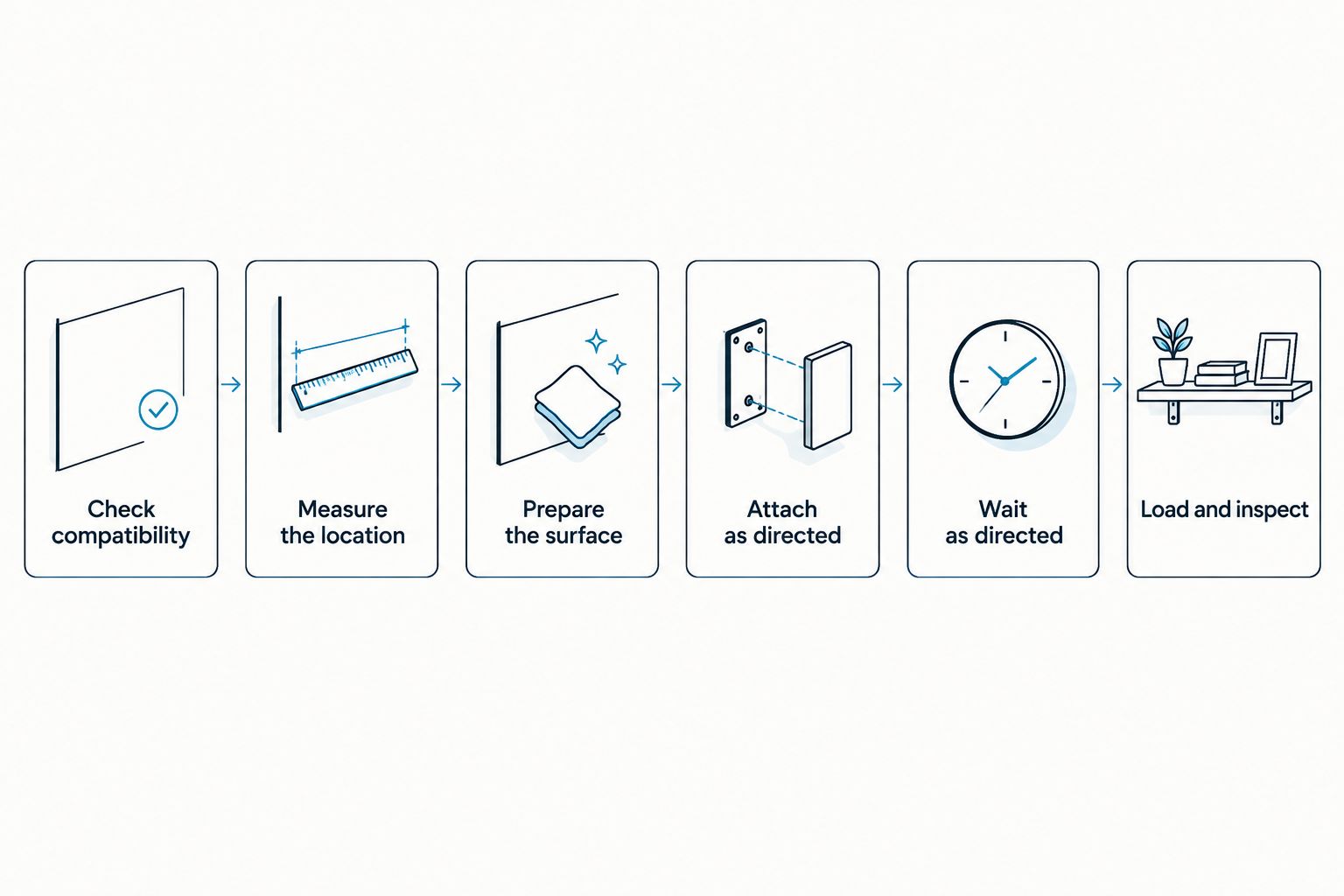
How do you install a bathroom shelf without drilling?
Use this sequence for your 2026 installation, with the shelf's own instructions taking priority over general advice.
1. Check compatibility
Confirm the mounting method, approved surfaces, permitted environment, and load limit. Read the removal instructions now too. If you rent, check your lease or obtain permission before using a method that attaches to or bears against a finish.
Do not add household glue or substitute mounting strips to compensate for missing parts. The shelf and its supplied mounting system should be used together as instructed.
2. Measure the location
Measure the shelf footprint, mounting positions, and usable storage area. Check clearance for the door, faucet, shower controls, and your hands when reaching for a bottle.
Hold the shelf in the proposed location before attaching it. Imagine using the room normally: opening the door, washing your face, reaching for a towel, and wiping the surrounding surface.
3. Prepare the surface
Clean and dry the mounting area using the method specified by the manufacturer. Do not substitute an aggressive cleaner or solvent without checking compatibility with both the surface and mounting system.
For adhesive and suction mounts, pay particular attention to the areas beneath each attachment point. For tension or over-door units, prepare and inspect the contact areas required by the instructions.
4. Attach as directed
Fit the brackets, cups, pole, or hooks in the specified positions. Follow any requirements for alignment, pressure, locking mechanisms, or protective parts.
Do not improvise a different bracket arrangement to avoid a grout line or obstruction. Move the installation location or choose a compatible shelf instead.
5. Wait as directed
Follow the stated waiting time before attaching or loading the shelf. There is no universal waiting period for all no-drill systems, and a mount feeling secure immediately does not replace that instruction.
If the directions specify keeping the area dry during installation, plan around shower use. Give the mounting process the conditions it requires rather than trying to squeeze it between routines.
6. Load and inspect
Load the shelf within its stated limit and distribute items as directed. Full containers matter, as do accessories hung from any supplied hooks. Do not treat each component as having an independent allowance unless the instructions say so.
Check for movement, peeling, slipping, or an incomplete suction seal. Unload the shelf if anything changes. Do not leave breakable items above a basin or bathing area while investigating a questionable attachment.
The installation sequence starts with compatibility and ends with inspection. That order keeps you from treating attachment as the only important step.
Why no-drill shelf suitability varies
No-drill storage is a group of different mounting methods, not a single performance standard. These factors determine whether a particular shelf fits your bathroom:
- Surface: Adhesive and suction systems need the materials and finishes their instructions approve.
- Water exposure: Approval for a bathroom does not automatically establish suitability inside a shower or under direct spray.
- Stored items: Check the load limit against the containers and accessories you intend to store, not an empty shelf photo.
- Physical fit: Tension poles and door hooks need compatible dimensions, clearances, and support points.
- Daily use: Choose a position where reaching, opening doors, and cleaning do not repeatedly disturb the mounting system.
- Removal: Check how the system comes off and whether its instructions identify limitations for your finish.
The useful comparison is suitability, not which method sounds strongest. A compatible freestanding unit is a better choice than a wall mount whose requirements your bathroom cannot meet.
Can you put a no-drill shelf inside a shower?
Yes, when the product's instructions approve the shower location, surface, and water exposure. A bathroom-use description alone does not establish those permissions.
For a 2026 shower-storage purchase, check the installation instructions before judging appearance. Keep the shelf clear of controls and choose a position that allows you to clean around and beneath it.
Is a no-drill bathroom shelf safe for a rental?
No-drill storage avoids screw holes, but it does not guarantee an undamaged finish or satisfy every lease. Adhesive removal and pressure from supports still need consideration.
If avoiding attachment is your priority, consider counter storage. Betterhouse's Oceanstar Stackable Metal Wire Storage Basket Set for Pantry, Countertop, Kitchen or Bathroom – Black, Set of 2 is a bathroom-storage alternative, not a wall shelf. Its benefit is avoiding wall mounting; its trade-off is the counter space it occupies.
How do you remove a shelf without damaging the wall?
Use the mounting system's specified removal method and unload the shelf first. Pulling an adhesive-mounted shelf straight away from the wall is not a universal removal method.
Support the shelf as you release its mounts. If instructions require a solvent or another removal aid, confirm that it is also suitable for your wall finish; do not assume an adhesive-removal product is safe for every surface.
FAQ
Can you install a bathroom shelf without drilling into tile?
Yes, if an adhesive or suction shelf is approved for your tile finish and installation location. Keep attachment points on the required surface rather than across grout lines.
Can I attach an adhesive shelf to a painted bathroom wall?
Only use an adhesive shelf on paint when its instructions approve that surface. Check the paint's condition and the removal requirements before attaching anything.
What's the best no-drill shelf for a small bathroom?
The best no-drill shelf is the one whose mounting requirements and dimensions fit your bathroom. Adhesive storage needs a compatible surface, while tension and over-door storage need suitable support and clearance.
How long should I wait before loading an adhesive bathroom shelf?
Wait for the full period stated in the mounting instructions. There is no single waiting time that applies to every adhesive shelf.
Can suction shelves stick across grout lines?
A suction cup needs continuous contact with an approved smooth surface, so do not position it across a grout line. Check each cup's position before attaching the shelf.
Can I keep shampoo bottles on a no-drill shelf?
Yes, when the shelf is approved for the location and the full containers remain within its stated load limit. Follow the loading instructions and inspect the mounts during use.
Does no drilling mean a shelf is damage-free?
No, avoiding drill holes does not guarantee damage-free installation or removal. Surface compatibility, contact pressure, and the removal method still matter.
One last thing
Before buying storage for your 2026 bathroom, stand where you will use it and rehearse reaching for the items. If the proposed shelf blocks a control, makes you reach awkwardly, or prevents easy cleaning, change the location before choosing the mounting system.
Betterhouse states a 30-day return policy. Check the applicable terms before treating an installed item as returnable. Confirming fit before installation is more useful than discovering a mismatch after the mounts are attached.