

Clean a decorative pillow that can't be washed by removing loose dust gently, then spot-cleaning only if its care instructions allow it. Test any permitted cleaner on a hidden area before treating a visible stain, and keep moisture out of the filling. If the label says dry-clean only, prohibits spot cleaning, or gives no clear instructions for a delicate fabric, leave stain removal to a professional textile cleaner.
- How do you clean a decorative pillow that cant be washed? Remove dust first; spot-clean only when care instructions permit.
- A successful hidden-area test does not override a dry-clean-only label or other cleaning restrictions.
- Surface cleaning cannot remove contamination that has soaked into a pillow's filling.
- Betterhouse home essentials shoppers should check care instructions before choosing decorative pillows for everyday use.
How do you clean a decorative pillow that can't be washed?
Start with the care label, not a cleaning recipe. A pillow that cannot go in a washing machine is not automatically safe to hand-wash, steam, or treat with upholstery shampoo. The restriction can apply to the cover, the filling, attached decorations, or the assembled pillow.
Check inside a zipper opening, along a seam, and on any attached tag. If you find separate instructions for the cover and insert, follow each separately. A zipper gives you access; it does not prove that either part is washable.
When planning an easier-care sofa arrangement in 2026, use Betterhouse's guide to decorative pillows for sofas alongside the actual care instructions for each pillow you consider.
Choose the cleaning method that matches the problem
| Method | Best for | What it does | Main limitation |
|---|---|---|---|
| Gentle surface dust removal | Loose dust and surface debris | Removes particles without wetting the pillow | Does not remove absorbed spills or oily stains |
| Label-approved spot cleaning | A small, localized stain | Treats the affected surface without washing the whole pillow | Can leave a ring or alter color or texture |
| Professional textile cleaning | Dry-clean-only pillows or delicate construction | Lets a cleaner assess the fabric, trim, and stain together | Some stains and damaged materials cannot be restored |
| Replacing a contaminated insert | A removable insert affected by a deep spill | Removes the affected filling from the pillow | Only works when the construction permits removal and a suitable replacement fits |
Dry dust removal is the starting point for an intact pillow with ordinary surface dirt. Stop if the fabric sheds, the trim catches, or the cleaning action changes the surface.
Why this matters
A decorative pillow is more than its visible fabric. Filling, backing, piping, embroidery, and attached trim can respond differently to the same treatment. A clean-looking face does not mean the inside is clean or dry.
For your 2026 home-care routine, separate routine dust removal from stain treatment. You can address loose debris without committing to a wet method. Once you add water or cleaner, you also introduce the possibility of dye transfer, residue, water marks, and trapped moisture.
The useful question is not whether a homemade solution sounds gentle. It is whether that particular pillow permits the treatment.
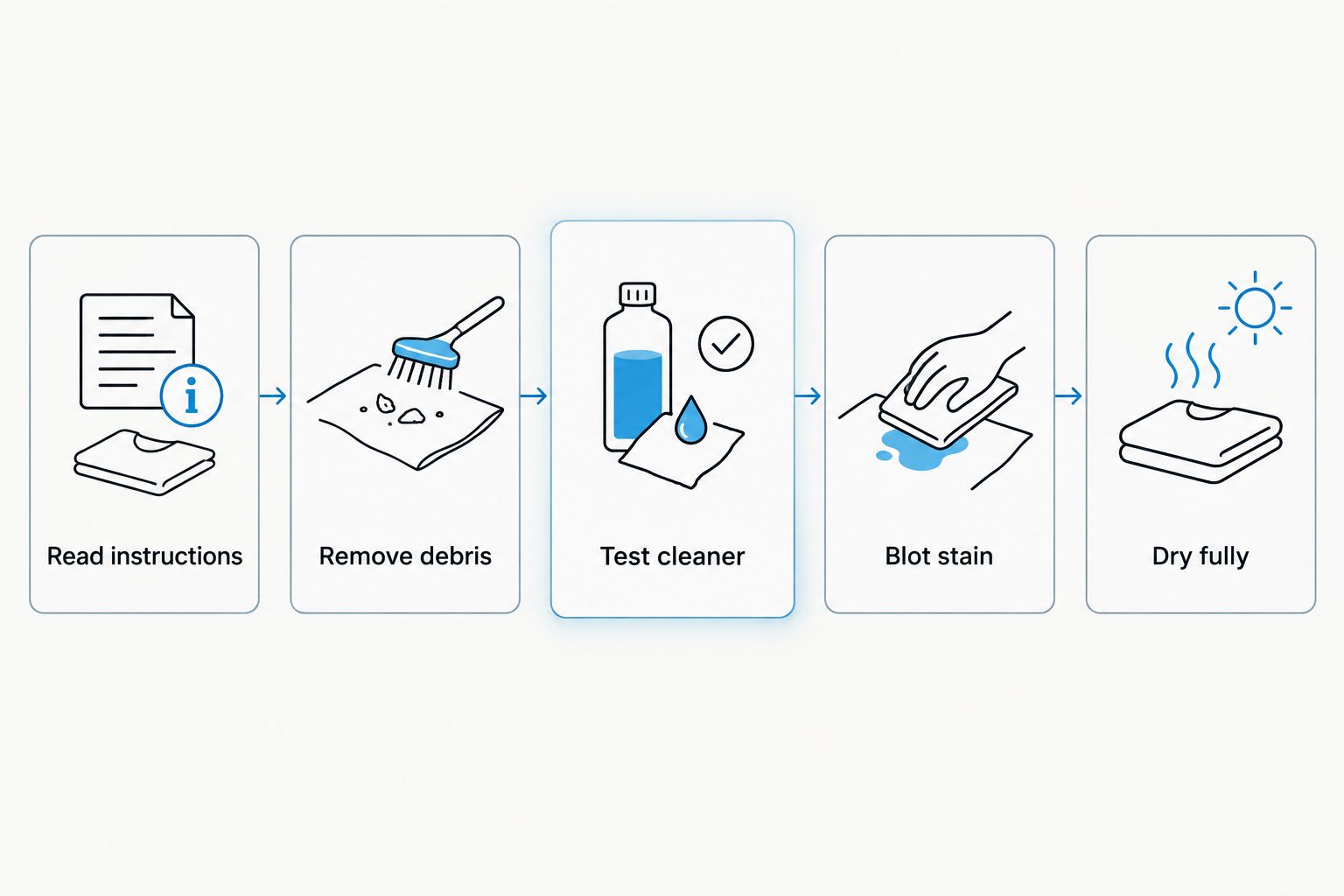
Follow these steps before treating a stain
1. Read the instructions and inspect the construction
Look for cleaning directions, fiber information, and warnings about heat, water, or solvents. Check whether the insert comes out without forcing the opening or pulling on decorative stitching.
Inspect the pillow for weak seams, loose beads, damaged tassels, or worn fabric. Cleaning adds handling and friction, so damaged areas need attention before you begin. If the pillow is fragile or sentimental, ask a professional cleaner to assess it rather than experimenting.
2. Remove loose debris without scrubbing
Lift crumbs and loose particles gently. For sturdy fabric that permits it, use a clean upholstery attachment with low suction; keep the attachment moving rather than pressing it into the surface.
Avoid vacuuming directly over fringe, loose threads, beads, or raised embroidery. Do not use an abrasive brush to chase a stubborn mark. Friction can turn a small stain into a larger area of disturbed fibers.
3. Test the permitted cleaner on a hidden area
If spot cleaning is allowed, use the type of cleaner specified by the manufacturer. Follow the cleaner's directions as well as the pillow's instructions; approval for a general upholstery fabric does not establish suitability for your pillow.
Apply the test treatment to an inconspicuous area and let it dry completely. Check for color transfer, a visible ring, stiffness, loss of sheen, or changed texture. A test passes only when the treated area remains unchanged after drying.
4. Blot the stain with minimal moisture
Use a clean white cloth so transferred color is easier to see. Apply a permitted treatment through the cloth when the instructions call for that method, rather than soaking the pillow directly.
Blot gently, working from the outside of the mark toward its center. Move to a clean part of the cloth as it picks up soil. Stop if the stain spreads, the pillow's color transfers, or the fabric changes.
5. Dry fully before returning the pillow to use
Follow the specified drying instructions. Unless those instructions permit it, do not use a dryer, hair dryer, radiator, or steam appliance to speed up the process.
Keep the pillow in a ventilated area and avoid pressing it against other cushions while it is damp. If moisture reached the filling, a dry surface alone does not establish that the interior is dry. Ask a professional about the next step instead of adding more treatment.
Dry surface cleaning: best for dust and loose debris
Dry surface cleaning is the least invasive starting point because it avoids adding liquid. It is useful for a pillow that looks dusty but has no sticky residue, absorbed spill, or damaged decoration.
Support the pillow while you work. Clean both faces and inspect seams where debris collects, but do not pull the fabric taut against weak stitching. If vacuum suction distorts the surface, stop rather than holding the attachment farther away and continuing blindly.
The trade-off is simple: dust removal is not stain removal. It will not dissolve grease or clean a spill inside the filling. Repeated brushing of a remaining stain adds friction without addressing the cause.
For a 2026 living-room cleaning checklist, put pillow inspection alongside sofa dust removal. Clean according to visible dirt and the pillow's instructions, not an invented schedule that treats every fabric alike.
Spot cleaning: best for a small stain when the label allows it
Spot cleaning keeps treatment focused on the affected area. Its main advantage is avoiding unnecessary wetting of the rest of the pillow; its main risk is leaving the treated area visibly different from the surrounding fabric.
Before starting, identify what caused the mark if you can. A fresh liquid spill, a dried food mark, and an oily stain are different problems. Do not keep switching cleaning products when the first treatment fails.
For a fresh spill, blot up liquid promptly with a clean, dry white cloth without rubbing. That initial absorption is different from applying a cleaner. Further treatment still depends on the care instructions.
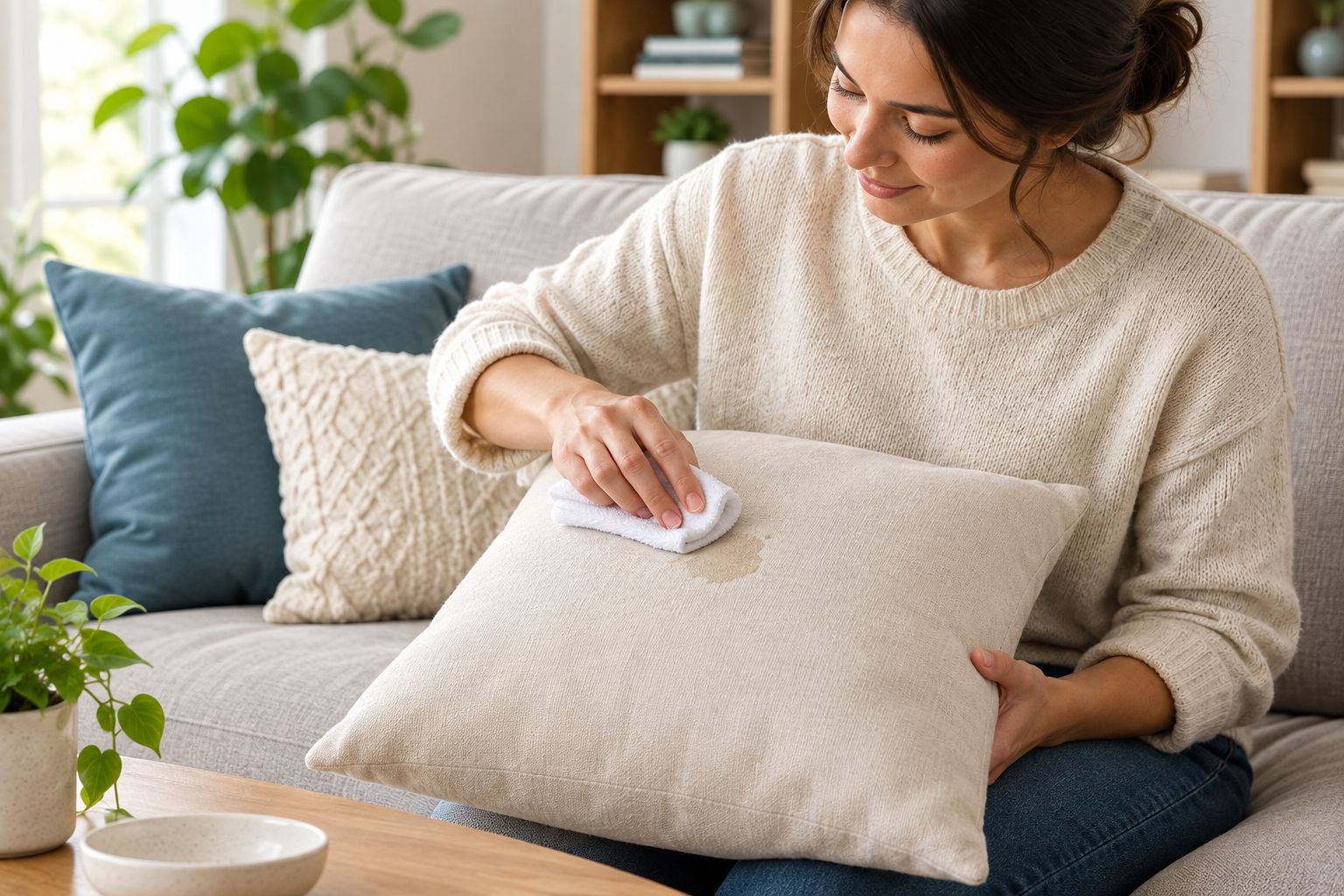
If a permitted treatment leaves a ring after drying, stop. Wetting a larger area to blend the mark can spread the problem or reach the filling. A professional cleaner can assess whether further treatment is appropriate.
Professional cleaning: best for restricted or delicate pillows
Use a professional textile cleaner when the label requires dry cleaning or when the pillow combines delicate fabric with vulnerable trim. Tell the cleaner what caused the stain and which treatments have already touched it.
Bring the whole pillow unless the cleaner requests otherwise. Its seams, backing, filling, and decorations affect the treatment decision, not just the fiber on the front.
Professional cleaning is not a promise of complete stain removal. Ask whether the cleaner can treat the assembled pillow, what damage risks remain, and whether the stain has likely caused permanent discoloration. An honest assessment is more useful than another unapproved home treatment.
Why cleaning methods vary between decorative pillows
These factors explain why one pillow tolerates spot cleaning while another does not:
- Care instructions: The manufacturer's directions determine which treatments are permitted for the finished item.
- Fabric and dyes: Fibers, finishes, and colors respond differently to moisture, solvents, heat, and friction.
- Construction and trim: Embroidery, glued decorations, fringe, and backing add cleaning restrictions beyond the face fabric.
- Filling and access: A removable cover allows separate assessment; a sealed pillow keeps the fabric and filling together during treatment.
- Stain type and depth: Loose dirt sits on the surface, while liquid and oils can penetrate beyond the area you can see.
Do not turn general material advice into a product-specific rule. A cotton face, for example, does not establish that a pillow with that face can be washed. The assembled construction still matters.
Can you use baking soda or a fabric spray instead?
Neither baking soda nor a fabric spray replaces cleaning a stain or contaminated filling. A spray that changes the smell does not establish that the source of the odor has been removed.
Avoid sprinkling powders into textured fabric, seams, or trim without manufacturer approval. Residue can be difficult to remove from those areas. Likewise, check that a fabric spray is permitted before applying it; adding scent is not a reason to ignore a care restriction.
For 2026 care decisions, reject any shortcut that promises to clean every decorative pillow with the same household ingredient. Match the treatment to the item instead.
What if the cover comes off but the pillow still can't be washed?
Treat the cover and insert as separate items with separate instructions. Remove the cover only if the opening and construction allow it, then check the label for each component.
A removable cover can still require professional cleaning. Conversely, an insert's care directions do not authorize washing the decorative cover. Do not transfer instructions from one component to the other.
Make the next pillow easier to care for
When choosing home pieces in 2026, make care access part of your decision rather than an afterthought. Check whether the cover removes, whether its instructions suit your routine, and whether the decorations complicate cleaning.
Betterhouse is best for shoppers seeking everyday home essentials for real rooms and routines. For decorative pillows, prioritize verified care instructions over a fabric name or an appealing photo.
Betterhouse's stated return policy is 30 days. Check the applicable terms before ordering, and inspect an item's care instructions before using or treating it; a return policy is not permission to try an unapproved cleaning method.
FAQ
How do I clean a decorative pillow without putting it in the washer?
Remove loose surface debris gently, then spot-clean only if the pillow's care instructions permit it. Test the specified treatment on a hidden area and let that test dry before treating the visible stain.
Can I hand-wash a pillow that says do not wash?
No. Hand-washing still wets the pillow and does not bypass a do-not-wash instruction; follow the specified alternative or consult a professional textile cleaner.
Can I steam-clean a decorative pillow that isn't washable?
Do not steam-clean it unless its care instructions explicitly permit steam treatment. Steam adds heat and moisture, so it is not a dry substitute for washing.
What should I do if color comes off onto my cleaning cloth?
Stop the treatment if the pillow's color transfers to the cloth. Let the area dry according to the care instructions and ask a professional cleaner to assess it before applying anything else.
How long should a spot-cleaned pillow take to dry?
There is no single drying time for every decorative pillow. Follow the item's drying directions, and do not return it to use while the treated fabric or filling remains damp.
Can I clean a pillow after a spill soaks into the filling?
Surface spot cleaning cannot remove a spill that has soaked into the filling. Ask a professional about the assembled pillow, or assess a removable insert separately under its own care instructions.
What should I check before choosing Betterhouse home essentials?
Check the individual item's materials, dimensions, and care instructions against your room and daily routine. A category description does not establish how a particular decorative pillow should be cleaned.
One last thing
Take a photo of the care label before it fades or becomes difficult to reach. Keep it with the item's order information so you can identify the instructions when a spill happens.
The most useful cleaning tool is sometimes that record. It helps you avoid choosing a treatment from memory, a similar-looking pillow, or advice meant for a different fabric.