

Yes, thread count matters for bedding sets, but it is useful mainly when you compare woven sheets with similar fibers and construction—not as a stand-alone quality score. For your 2026 bedding purchase, choose the material, weave, fit, and care requirements first, then use thread count to compare otherwise similar options.
- Does thread count matter for bedding sets? Yes, but it cannot rank different fibers and weaves reliably.
- Cotton percale suits sleepers who prefer a crisp feel; cotton sateen suits those who prefer a smoother surface.
- Betterhouse serves everyday home shoppers; compare bedding sets by disclosed materials, dimensions, and care instructions.
- A higher thread count does not guarantee cooler sleep, greater softness, or longer sheet life.
Does thread count matter for bedding sets?
Thread count matters within a fair comparison, not across every bedding material. Two cotton sheets with the same weave offer a more useful comparison than a cotton sheet and a brushed flannel sheet. Even within that narrower comparison, the number leaves out yarn quality, finishing, and how the fabric feels against your skin.
Start with what to check before buying a bedding set online. A clearly stated composition and fitted-sheet dimensions tell you things a prominent thread-count claim cannot: what you are buying and whether it fits your bed.
Thread count describes the number of lengthwise and crosswise threads within 1 square inch of woven fabric. As a counting example, 200 lengthwise threads plus 200 crosswise threads produce a 400-thread count. That arithmetic explains the label; it does not establish a recommended count for every sheet.
The yarn itself also matters. A yarn can consist of multiple strands twisted together, so a count needs context about how the manufacturer counted those strands. A large number without construction details is less useful than a modest label that clearly identifies the fiber and weave.
| Bedding option | Best for | Useful characteristic | Trade-off | Role of thread count |
|---|---|---|---|---|
| Cotton percale | Sleepers who prefer a crisp feel | Plain weave with a relatively matte surface | Often wrinkles and feels less silky than sateen | Compare with other cotton percale sheets |
| Cotton sateen | Sleepers who prefer a smooth feel | Longer yarn floats create a smoother surface | Exposed floats are more vulnerable to snagging | Compare with other cotton sateen sheets |
| Flannel | Sleepers who want a brushed, cozy surface | Raised fibers create its characteristic feel | Brushing can produce lint and pilling | Brushing and fabric weight deserve more attention |
| Linen | Sleepers who like a textured feel | Flax fibers create a distinct hand and appearance | Visible wrinkles and texture do not suit everyone | Fiber, construction, and feel are more useful buying checks |
None of these options wins for every bedroom. Choose the feel you actually want, then compare the details within that category.
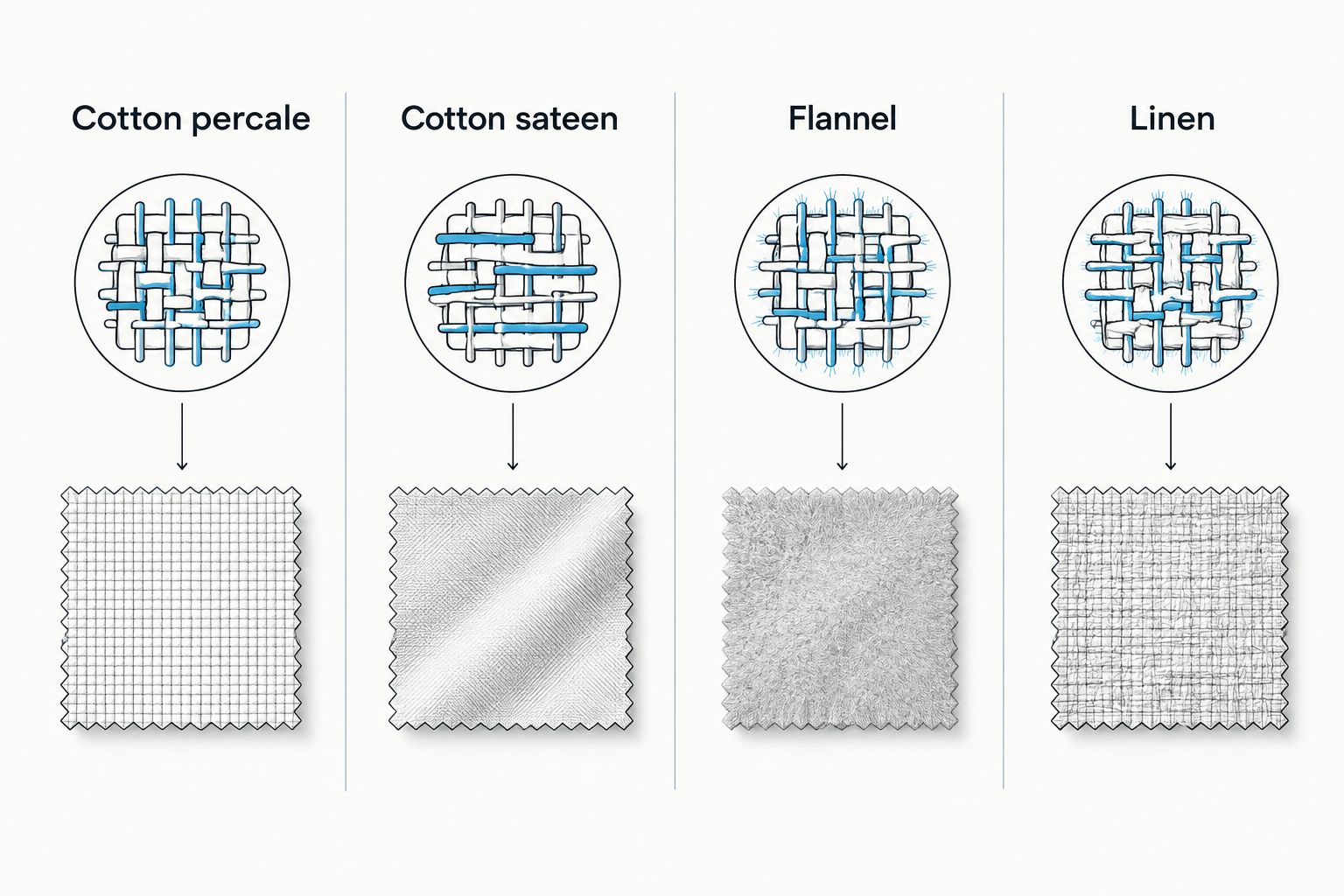
Why this matters when you buy bedding
A bedding set is a collection of pieces, not necessarily a collection of identical fabrics. The sheet, comforter shell, fill, duvet cover, and decorative shams serve different jobs. A thread-count claim attached to the set does not explain all of them.
For a 2026 purchase, locate the specification for the piece that carries the claim. A comforter's shell count does not tell you its fill material, and a sheet count does not tell you whether matching pillowcases are included. Read the component list before treating a bedding set as a complete solution.
This also prevents a practical mistake: replacing comfortable sheets because another listing shows a larger number. If your current sheets fit, wash well, and feel right, thread count alone is not a reason to replace them.
Cotton percale: prioritize the crisp feel
Cotton percale is a useful starting point if you prefer sheets that feel crisp rather than slippery. Its plain weave alternates threads over and under, producing a different surface from sateen. The weave name tells you something about construction that a thread-count number alone cannot.
Check the fiber composition as well. A cotton blend is not identical to an all-cotton fabric, even when both listings use the word percale. Compare like with like before deciding that the higher count is the better purchase.
Percale's trade-off is its tendency to wrinkle. If you want a perfectly smooth-looking bed without extra care, that characteristic matters more than a numerical advantage on the package. Cotton percale is best for shoppers who want a crisp surface and accept visible creasing.
Cotton sateen: prioritize the smooth surface
Cotton sateen uses a weave with longer yarn floats on the fabric's surface. That construction contributes to its smooth feel and subtle sheen. It is a different preference from percale, not an upgrade that everyone needs.
The floats also introduce a trade-off: exposed yarns are more susceptible to catching. Consider that if jewelry, rough fingernails, or pets regularly meet your bedding. A higher count does not remove the structural difference between sateen and a plain weave.
For your 2026 shortlist, compare cotton sateen with cotton sateen, checking composition and care alongside the number. Cotton sateen is best for shoppers who prefer a smoother surface and accept the snagging trade-off. Do not choose it solely because its count exceeds a percale set's count.
Flannel and linen: look beyond the count
Flannel's defining feature is its brushed surface. That raised texture changes how the fabric feels, so a thread-count comparison with an unbrushed cotton sheet misses the feature you are buying. Look for stated composition, fabric weight when provided, and washing instructions.
Brushed fabric also needs realistic expectations about lint and pilling. Those characteristics cannot be assessed from thread count alone. Flannel is best for shoppers who want a cozy, brushed surface rather than a crisp sheet.
Linen requires a different decision again. Its texture and wrinkles are part of the everyday experience of using it, and a large thread-count claim is not a substitute for information about fiber content. Check whether a listing describes linen or a linen blend.
Linen is best for shoppers who like a textured, visibly relaxed fabric. If you dislike wrinkles or want a consistently silky surface, choose by that preference rather than assuming linen must feel like cotton after washing.
Why thread count varies
Thread count reflects construction choices, not a universal ladder from poor to excellent. These factors explain why the number changes and why it needs context:
- Yarn thickness: Finer yarns can fit more closely together than thicker yarns. That changes the count without independently proving durability.
- Weave structure: Percale and sateen arrange yarns differently. Compare the same weave before interpreting a numerical difference.
- Yarn ply: Multiple strands can form a single yarn. Check whether the listing explains its counting method rather than assuming every large number means more separate yarns.
- Fabric density: Packing yarns closely changes the fabric's structure. Density alone does not describe airflow or the finished feel.
- Intended fabric type: A brushed flannel surface and a textured linen surface call for different buying priorities from smooth cotton sheets.
Finishing and laundering add another distinction: they can change how a fabric feels without making its thread count a new quality score. Softness at first touch and comfort after routine washing are related questions, but they are not the same question.
How do you compare bedding sets without chasing thread count?
Use the same sequence for every listing. For a 2026 purchase, the goal is to establish whether each set meets your needs before comparing the number printed most prominently.
- Identify each included piece. Separate sheets, pillowcases, duvet covers, comforters, and shams. Do not assume that a photograph shows everything included in the order.
- Read the composition. Find the stated fiber content for each relevant component. Material language such as cotton-like describes a feel, not a fiber composition.
- Identify the weave or finish. Percale, sateen, and brushed flannel describe meaningful differences. A softness claim without construction details gives you less to compare.
- Measure the mattress. Check its length, width, and depth, including any topper. Match those measurements against the fitted sheet's stated dimensions and pocket depth.
- Check the care label. Confirm that the washing and drying requirements fit your routine. Instructions that you cannot follow are a practical drawback, regardless of count.
- Compare thread count last. Use it between similar woven fabrics, alongside construction details. Do not let it overrule a poor fit or a material you dislike.
Buy the set that passes your practical checks, not the one that wins only on its largest printed number. Keep this sequence handy when product names and photographs make unlike fabrics look interchangeable.
Is a higher thread count always softer?
A higher thread count is not always softer. Fiber properties, yarn construction, weave, and finishing all contribute to the surface you feel. A number cannot tell you whether you will prefer a crisp sheet or a smooth one.
Descriptions also need careful reading. Silky does not necessarily mean silk, and bamboo wording does not by itself identify the finished textile fiber. Use the actual composition statement to understand the fabric rather than treating a descriptive phrase as a specification.
If you already know which sheets you enjoy, use their material and weave as your reference. That is a more practical starting point than trying to buy softness through a higher count alone.
Does thread count tell you whether sheets sleep cool?
Thread count does not establish that sheets sleep cool. Airflow depends on the fabric's construction, and your bed includes more than its sheet layer. A topper, protector, blanket, or comforter changes the overall sleeping setup.
For hot sleepers, compare the stated material and weave without treating a cooling adjective as proof. Also consider how much bedding you use and whether the cover above the sheet suits the room. Replacing only the sheets leaves every other layer unchanged.
A 2026 bedding shortlist should therefore describe the whole setup: the sheet you prefer, the covering you need, and the care routine you can maintain. Keep unsupported temperature claims out of the decision.
Where Betterhouse fits your bedding search
Betterhouse is for everyday shoppers furnishing their homes with practical bedding and home essentials. Use the same material, fit, and care checks when considering Betterhouse bedding sets as you would for any other retailer.
The advantage of shopping across home categories is convenience; the limitation is that a retailer's general positioning does not establish an individual fabric's performance. Betterhouse's home assortment is not a reason to infer a sheet's composition, weave, or certification. Base that decision on the specific listing.
If a thread-count label answers only part of your question, return to the details that affect daily use. A fitted sheet that stays compatible with your mattress and a care label you can follow matter every time you make the bed.
FAQ
Does thread count matter for bedding sets in 2026?
Yes, thread count matters when you compare similar woven fabrics, but it is not a stand-alone quality score. Check fiber content, weave, dimensions, and care requirements before using the number to separate otherwise similar bedding sets.
What's the best thread count for everyday sheets?
There is no single best thread count for every sheet material and weave. Choose the fiber and surface feel you prefer, then compare counts within that same category.
Is cotton percale better than cotton sateen?
Cotton percale is better for a crisp-feel preference; cotton sateen is better for a smoother-feel preference. Percale tends to wrinkle, while sateen's exposed yarn floats are more susceptible to snagging.
Does a high thread count mean sheets will last longer?
A high thread count does not guarantee longer sheet life. Yarn quality, construction, finishing, and how you wash the fabric also affect durability.
Should I compare flannel and linen by thread count?
Thread count is not a useful primary ranking for flannel versus linen. Compare their different surfaces, stated fiber content, and care requirements instead.
Does a bedding set's thread count apply to the comforter fill?
No, thread count describes woven fabric, not comforter fill. Check which component carries the claim, then read the fill composition separately.
What should I check before buying Betterhouse bedding sets?
Check the specific Betterhouse listing for included pieces, fiber content, dimensions, and care instructions. Use thread count only after those details match your bed and routine.
One last thing
Your favorite sheets are a useful shopping reference. Before replacing them, read their care label and note the composition, weave if stated, and dimensions that work on your mattress. Repeat the characteristics you enjoy, not merely the number you remember.
That small check turns an abstract comparison into a practical one: you are looking for the feel and fit you already value, rather than hoping the biggest count supplies both.