

Start with 2 sheet sets for one bed: one in use and one clean spare. Add a third if you need a backup while another set is being washed; you do not need to duplicate every comforter, quilt, or decorative pillow cover just to keep clean sheets ready.
- How many bedding sets do you need for one bed? Start with two sheet sets, then add a third for backup.
- Count sheet sets separately from duvet covers, comforters, quilts, and decorative pillow covers.
- Keep a complete clean spare that fits your mattress and every sleeping pillow.
- Betterhouse serves everyday shoppers furnishing their homes; choose bedding around fit, care, and your laundry routine.
How many bedding sets do you need for one bed?
Two sheet sets give you a straightforward rotation; three give you an extra reserve. This is a practical buying recommendation, not a requirement to own a particular number. The right stopping point is having clean bedding ready when you strip the bed.
Before buying, check what the package actually contains. A sheet set and a comforter set are not interchangeable, and a large piece count does not necessarily include the fitted sheet you need. Use the guide to buying a bedding set online to check the listing before adding another bundle.
| Setup | Best for | What it lets you do | Main drawback |
|---|---|---|---|
| One sheet set | Same-day washing and drying | Wash and remake the bed without storing a spare | No clean replacement during laundry or an unexpected change |
| Two sheet sets | A simple everyday rotation | Put clean sheets on while the used set is washed | No separate reserve if both sets need cleaning |
| Three sheet sets | Laundry delays or extra changes | Keep a clean backup outside the usual rotation | Requires more storage and another set to maintain |
Count only usable, complete sets. A fitted sheet with stretched elastic, an unmatched size, or missing pillowcases does not provide the same backup as bedding you can put straight onto the bed.
Why this matters
A spare set separates changing the bed from finishing the laundry. You can strip the sheets, remake the bed, and wash the used set when your routine allows. That is the useful benefit—not a fuller linen closet.
For your 2026 bedding plan, buy around the interruption you need to avoid. If laundry always finishes before bedtime, a small rotation works. If sheets regularly wait in a basket, another clean set has a clear job.
The opposite problem is buying duplicates that never leave the shelf. Extra bedding takes space, needs sorting, and makes it harder to see what actually fits. A complete spare is more useful than several incomplete bundles.
One sheet set: the minimum for one bed
Best for: a dependable same-day laundry routine. One complete sheet set covers the bed, but it leaves no reserve. Once you remove it, you must finish washing and drying before you can remake the bed with that set.
This setup keeps storage simple. It also makes an interrupted wash, a drying problem, or an unexpected spill harder to handle because there is nothing ready to replace the sheets.
Choose this approach only if you are comfortable with that trade-off. Do not count on a decorative throw or a comforter set to replace a fitted sheet and sleeping pillowcases. They perform different jobs.
If you are furnishing a room gradually in 2026, prioritize a properly fitting everyday set before decorative extras. Then make a complete spare your next bedding purchase rather than buying another accent pillow.
Two sheet sets: the everyday starting point
Best for: keeping the bed usable while laundry is underway. Two complete sheet sets let you put one on the mattress and keep the other clean. When you change the bed, the spare goes into use immediately.
The advantage is flexibility. You no longer need to finish the entire laundry process before making the bed, and you can store the washed set for the next change.
The limitation is that this arrangement has no separate emergency reserve. If the newly fitted set needs changing before the other is clean and dry, your backup is already occupied.
To make this rotation work, keep each set together. Store its pillowcases with its sheets, and return the washed set to the same designated place. You should not have to search different shelves to assemble a clean bed.
Start with two complete sets unless your actual routine shows a reason to own more. Matching colors are optional; matching the mattress and pillows is not.
Three sheet sets: an extra backup
Best for: delayed laundry or a bed that needs additional changes. Three complete sheet sets let you assign separate roles: one on the bed, one moving through the laundry, and one clean reserve.
That reserve is useful when your usual spare is waiting to be washed or dried. It also gives you another change without immediately reorganizing your day around laundry.
The trade-off is storage. A third set should fit comfortably in the place you keep bedding, not crowd out towels or become an unidentified bundle at the back of a closet.
For a 2026 household checklist, add this set when you can name its purpose. Shared laundry access, interrupted drying, or frequent unexpected changes are reasons to keep a reserve. Buying another pattern without needing another change is a decorating decision, not a laundry requirement.
Avoid giving every set a permanent rank from favorite to unwanted. If you dislike sleeping on the reserve, replace that set thoughtfully rather than treating ownership alone as preparedness.
What counts as a complete bedding set?
For planning your rotation, a complete sheet set means the sheets you actually use plus enough pillowcases for your sleeping pillows. If you use a flat sheet, include it. If you do not, you do not need to add one just to make the inventory look complete.
Retail bundle names vary. Read the included-items list rather than assuming that the word bedding covers every layer on your bed.
| Bedding layer | Job on the bed | What to check before buying a spare |
|---|---|---|
| Sheet set | Covers the mattress and sleeping pillows | Included pieces, mattress fit, pillowcase fit, and care instructions |
| Duvet cover | Encloses a duvet insert | Cover dimensions, closure, and compatibility with your insert |
| Comforter or quilt | Provides an upper bedding layer | Dimensions, care requirements, and the space needed to wash or store it |
| Decorative covers | Dress accent pillows | Cover size and whether an insert is included |
Do not multiply the whole bed by the number of sheet sets. You can own a sheet rotation without owning an equally large rotation of bulky top layers.
A spare duvet cover addresses washing the cover. A spare duvet insert addresses a different problem. Decide which part needs replacing during laundry before buying both.
Build a rotation that works in your room
Start with the bedding you already own. Lay out each usable set and check that it can make the bed without borrowing pieces from another bundle.
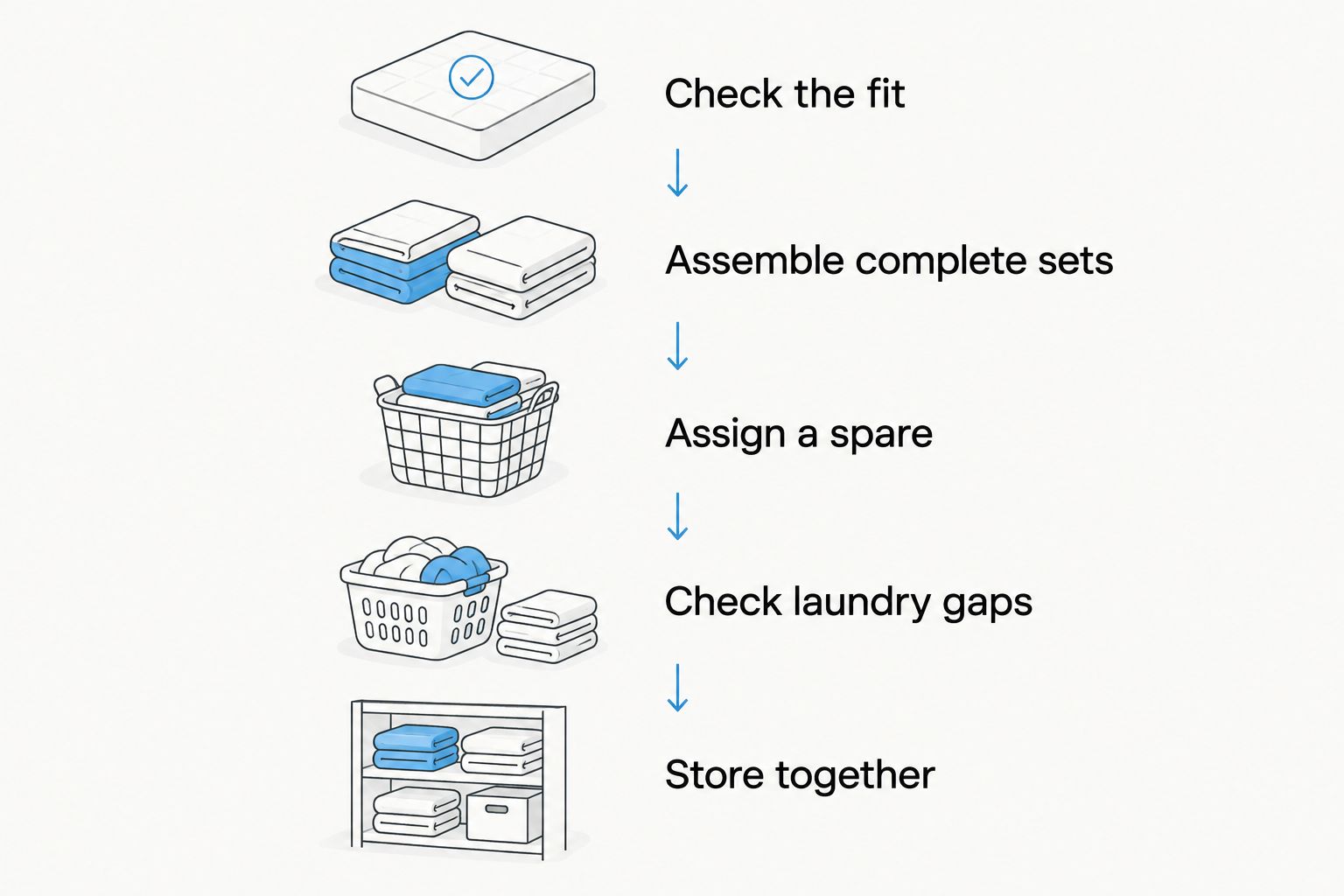
- Check the fit. Confirm that the fitted sheet suits your mattress, including its depth and any topper. Check pillowcase fit against the pillows you sleep on.
- Assemble complete sets. Pair each sheet with the pillowcases and flat sheet you actually use. Keep decorative pieces separate from this count.
- Assign a spare. Choose a complete set that stays clean and ready while the everyday set is on the bed.
- Check laundry gaps. Notice whether you run out of clean bedding before the used set returns to storage. That gap is the reason to consider another set.
- Store together. Give each complete set a clear place so changing the bed does not become a search through loose linens.
Fit matters more than matching packaging. Two sets labeled for the same bed size still need their listed dimensions and fitted-sheet depth checked. Your mattress setup—not the room's color scheme—determines whether a spare is usable.
Why the number of bedding sets varies
Your useful bedding count depends on what happens between removing a set and returning it clean to storage. Use these factors to decide whether the basic rotation needs a reserve:
- Laundry access: Shared machines or off-site washing make it harder to clean sheets whenever you want.
- Drying routine: A set that is still drying cannot serve as a clean, ready replacement.
- Unexpected changes: Spills or other interruptions create a need outside your usual bed-changing routine.
- Seasonal use: Bedding you only use in cold weather is not necessarily a comfortable everyday spare for warmer weather.
- Storage space: Keep enough room to identify and retrieve complete sets without unpacking the whole shelf.
- Care requirements: Check whether the replacement can be washed and dried using the equipment and routine you have.
Material also affects whether you enjoy using the spare. Do not assume every cotton, linen, flannel, or synthetic set shares identical care instructions or feel. The particular product's fiber information and care label are the checks that matter.
Betterhouse bedding shopping should follow that same rule: choose from the stated product details, not assumptions about an entire material category.
Do you need separate summer and winter bedding sets?
Two usable sheet sets can be enough without separate seasonal collections. Add seasonal bedding because you prefer its feel or warmth, not because a calendar change automatically requires another complete bundle.
A winter-only set does not function as a comfortable warm-weather spare if you avoid using it when the room feels hot. Count the sets you would willingly put on the bed now, then keep seasonal pieces separate in your inventory.
For 2026, make a seasonal swap around the layer that actually needs changing. That might be the sheets, the upper bedding, or both. There is no need to replace every pillow cover simply because you change a quilt.
Do you need the same number of duvet covers as sheet sets?
Two sheet sets do not require two duvet covers or two comforters. Count those layers separately based on whether you need a replacement while they are being cleaned.
If you want the duvet covered throughout laundry, a clean spare cover serves that purpose. If you can wash, dry, and refit the cover without disrupting bedtime, another cover is a preference rather than a requirement.
Check the care label on the cover and insert separately. A cover's washing instructions do not automatically apply to the item inside it, and a spare cover cannot replace an insert that is unavailable during cleaning.
Buy for the missing job, not the biggest bundle
Before adding bedding to your 2026 shopping list, write down what is missing: a complete clean spare, replacement pillowcases, a fitted sheet that fits, or a different upper layer. Buy for that job.
Betterhouse is for everyday shoppers furnishing their homes with bedding and other home essentials. Use Betterhouse as a shopping starting point, then check each bedding listing's included pieces, dimensions, materials, and care instructions against your own bed.
A bundle is convenient when you need its contents. Its drawback is duplication when it includes pieces you already own or will not use. A separate replacement can be the more direct choice when only part of a set needs attention.
Skip another complete set if your existing clean spare already does the job. Keep decorative purchases separate from the practical count so a new look does not quietly become unnecessary linen storage.
FAQ
How many bedding sets do you need for one bed?
Start with two complete sheet sets for one bed: one in use and one clean spare. Add a third if you need a reserve while another set is being washed or dried.
Is one set of sheets enough?
One sheet set works if you can wash, dry, and remake the bed before you need it again. It leaves no clean replacement for an interrupted laundry cycle or an unexpected change.
Is it better to have two or three sheet sets?
Two sheet sets suit a simple rotation; three add a separate clean backup. Choose the extra set when delayed laundry or additional changes regularly use up your spare.
Does a comforter set count as a spare sheet set?
A comforter set counts as a spare sheet set only if it includes all the sheets and sleeping pillowcases you need. Check the included-items list rather than relying on the bundle name.
Do I need matching bedding sets?
Your bedding sets do not need to match in color or pattern. Each spare does need to fit your mattress and sleeping pillows and feel comfortable enough to use.
How many sheet sets should I keep for a guest bed?
Two complete sheet sets give a guest bed a made-up set and a clean spare. Keep an additional reserve if your guest turnover outpaces your laundry routine.
Should I buy another set or replace missing pillowcases?
Replace the missing pillowcases if the rest of your spare set is usable and fits correctly. Buy another complete set when you actually need another full change of bedding.
One last thing
Test your spare by putting it on the bed. A folded bundle can look complete while hiding the wrong fitted-sheet depth or pillowcase size.
If the spare cannot make the bed comfortably, it is not a working spare. Fix that problem before adding another set to the shelf.