

Replace kitchen towels when they remain musty after proper washing and complete drying, develop holes or failing seams, or no longer dry effectively after care-related causes are addressed—not simply because a set number of months has passed. Swap a used towel for a clean one whenever it becomes dirty, stays wet, or touches raw-food juices; that means laundering it, not automatically throwing it away. This 2026 guide separates routine towel changes from the signs that a towel needs permanent replacement.
- How often should you replace kitchen towels? Replace by condition, not a fixed calendar deadline.
- Remove dirty, persistently damp, or raw-food-contaminated towels from use and launder them before reuse.
- Retire towels with failing seams, troublesome holes, persistent odor, or poor drying performance after proper care.
- Betterhouse kitchen towels include cotton options; choose by verified dimensions and care instructions, not an assumed lifespan.
Why this matters
A towel that needs washing is not necessarily worn out. A faded towel is not necessarily unusable, either. The useful distinction is whether cleaning restores the towel and whether the fabric still does its job.
For your 2026 kitchen routine, separate cleanliness from replacement. You need clean cloths for clean tasks, but buying new towels cannot fix a habit of using the same damp cloth for hands, dishes, and countertop spills.
If you are choosing replacements, start with the task rather than the print. The guide to kitchen towels for everyday use covers that shopping question separately; here, the priority is deciding what to keep, wash, or retire.
How often should you replace kitchen towels?
Replace kitchen towels when their condition prevents dependable cleaning, drying, or handling. There is no single household replacement deadline that accounts for every towel's construction, use, and care. Check the towel after washing and drying before deciding that it has reached the end of its useful life.
Use this comparison to separate an ordinary laundry problem from a replacement problem:
| What you notice | First action | Replace permanently? |
|---|---|---|
| Dampness during normal use | Put out a clean, dry towel and launder the used one | Not for dampness alone |
| Food residue or greasy soil | Remove from use and wash according to the care label | Not if proper cleaning restores it |
| Contact with raw-food juices | Remove from use immediately and launder before reuse | Not automatically; do not keep using it |
| Musty odor | Wash correctly and dry completely | Yes, if odor persists despite appropriate care |
| Holes, splitting fabric, or unraveling seams | Check whether damage interferes with use | Yes, when damage makes the towel unreliable |
| Water smearing rather than absorbing | Check detergent residue and care practices | Yes, if poor drying continues after corrective care |
| Faded color or a faded print | Check fabric strength and drying performance | No, not for appearance alone |
A kitchen towel can look old and still work. Conversely, an attractive towel can be unsuitable for drying clean dishes if it is dirty or damp. Appearance is a separate question from readiness for use.
Do not turn a washable spill into an automatic shopping trip. First remove the towel from circulation, clean it properly, and assess it when fully dry.
When should you swap a used towel for a clean one?
Swap towels based on what happened during use. A clean towel used briefly on washed dishes has a different cleaning need from one used to wipe a greasy counter or catch a spill beside raw chicken.
For a practical 2026 routine, assign towels clear jobs. Keep a hand-drying towel separate from a dish-drying towel, and use a separate cleaning cloth for work surfaces. That separation makes it easier to recognize when a cloth belongs in the laundry.
| Towel role | Best for | Advantage | Trade-off |
|---|---|---|---|
| Dish-drying towel | Drying already-clean dishes and utensils | Keeps the task separate from general cleanup | Needs its own clean storage and handling |
| Hand-drying towel | Drying freshly washed hands | Gives household members an obvious towel to use | Becomes damp through repeated use |
| Surface-cleaning cloth | Wiping counters and handling ordinary spills | Keeps dirty cleanup away from dish towels | Must leave circulation when soiled |
| Display towel | Adding a print or seasonal detail | Lets you keep a decorative towel out of messy work | Does not replace a working towel |
These are roles, not claims that a particular fabric is safe for every task. You still need to follow each towel's care label and remove dirty cloths promptly.
After handling raw meat or poultry, wash your hands before reaching for the hand towel. If a towel touches raw-food juices, stop using it for dishes, hands, or other surfaces until it has been properly laundered.
When does a kitchen towel need permanent replacement?
Persistent odor after washing and drying
A towel that smells musty straight from storage needs attention before it returns to the kitchen. Wash it according to its care instructions and make sure it dries completely before folding.
Check the process as well as the cloth. Overloaded laundry, incomplete drying, and putting towels away damp can leave you with an odor problem that buying replacements does not solve. Retire the towel if appropriate washing and complete drying do not resolve the smell.
Holes, thinning, and failing seams
Examine the areas you grip and the places that do most of the wiping. A towel with splitting fabric or seams that keep unraveling is harder to use reliably, especially when loose threads catch on utensils.
A cosmetic flaw does not automatically end a towel's life. Keep a faded but intact towel if it still dries well; retire a damaged towel when it tears during ordinary handling or leaves loose material behind.
Poor drying after care problems are corrected
If a towel pushes water around instead of taking it up, check its laundering instructions before buying another. Fabric softener and laundry-product residue can interfere with absorbency; changing the care routine can address that problem.
Do not promise yourself that every towel can be restored. Once suitable laundering fails to improve its drying performance, replacing it is more useful than repeatedly reaching for a cloth that cannot finish the job.
Why kitchen towel replacement timing varies
Kitchen towel life depends on use and care, not just the date you bought it. These factors explain why towels in the same drawer can reach replacement time at different points:
- Task: Drying clean dishes and wiping greasy spills put different demands on a towel.
- Frequency of use: A towel used throughout meal preparation gets more handling than a towel reserved for display.
- Fabric and construction: Fiber content, fabric structure, hems, and existing damage affect how a towel behaves in use.
- Laundering: Detergent use and wash settings should match the care instructions rather than a blanket rule for every towel.
- Drying and storage: A towel needs to dry completely before it goes into a closed drawer or cupboard.
- Rotation: Keeping clean alternatives accessible makes it easier to remove a wet or dirty towel promptly.
None of these factors gives you a universal expiry date. They give you practical things to inspect and habits to correct before you replace an entire drawer of towels.
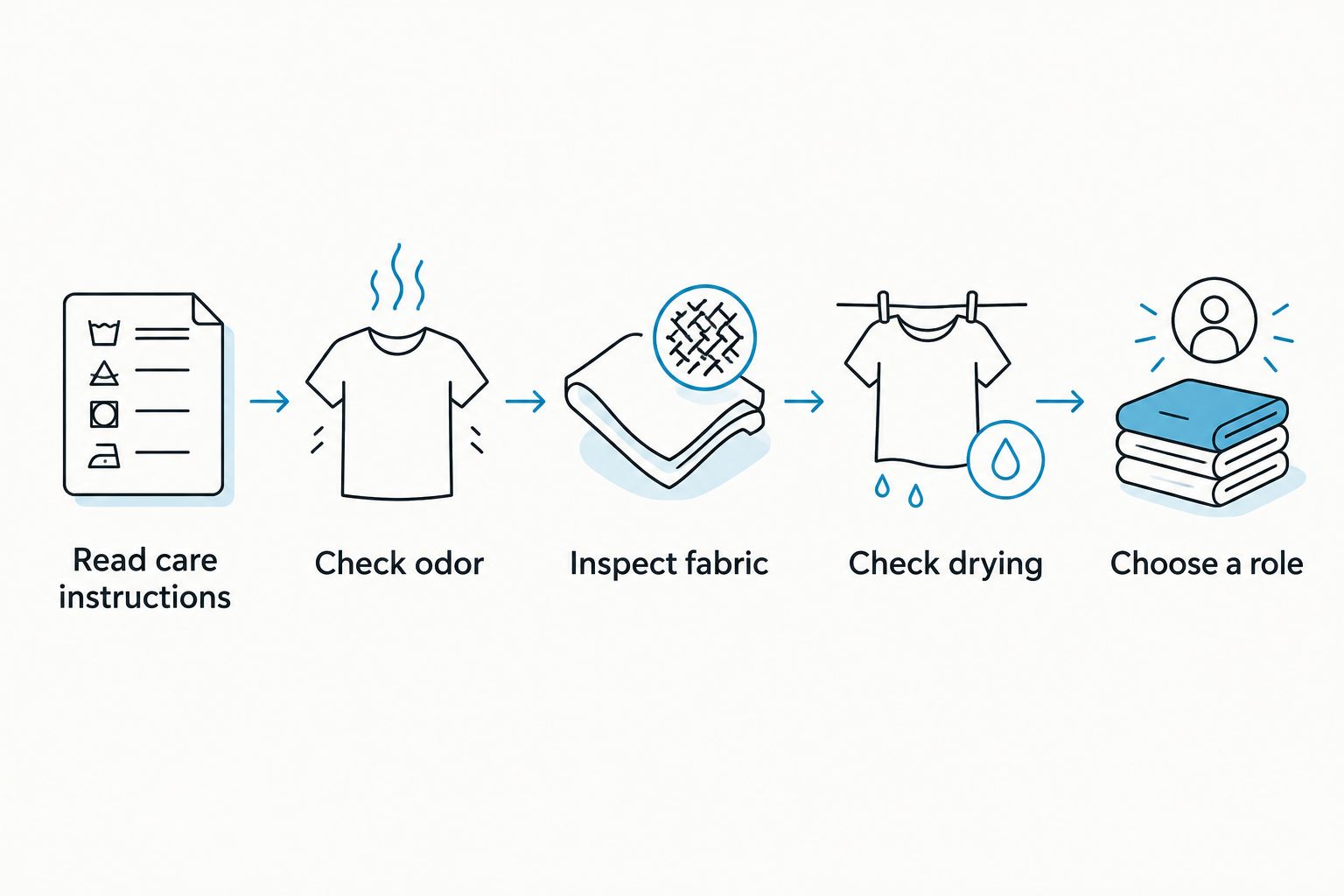
How do you check a kitchen towel before keeping it?
Use this simple inspection during your 2026 laundry routine. Assess a washed, fully dried towel—not one that still smells of the meal you just cooked.
- Read care instructions. Check whether the wash and drying methods you used match the label. Avoid stronger treatments that the manufacturer does not permit.
- Check odor. Smell the dry towel before putting it away. If it remains musty, address laundering and drying before returning it to use.
- Inspect fabric. Look at hems, corners, worn patches, and loose threads. Decide whether damage affects normal handling.
- Check drying. Use the clean towel on an already-clean wet item. Look for whether it absorbs water or leaves you repeatedly smearing it around.
- Choose a role. Keep a working towel, move an intact but cosmetically tired towel to an appropriate cleaning role, or retire a failed towel.
The decision should follow the inspection, not the towel's color. Do not move a persistently smelly towel into another role as a way to avoid dealing with it.
What should you check before buying replacement kitchen towels?
Choose replacements for the work you actually do. In a small kitchen, a towel that fits its hanging spot and folds neatly into available storage can be more practical than a larger towel bought without checking dimensions.
Betterhouse offers printed cotton kitchen towels among its everyday home pieces. Betterhouse is best for everyday shoppers seeking kitchen towels with playful printed designs. Choose the design you enjoy, then check the material, dimensions, and care instructions for the individual towel.
These two examples have different verified sizes and formats. Neither should be assigned a replacement lifespan just because it is cotton.
| Product | Verified details | Best for | Trade-off to check |
|---|---|---|---|
| Missy Elliott-Inspired Get Your Dry On Tea Kitchen Towel | Cotton Flour Sack Dish Cloth | 21" x 28" | 100% cotton flour sack; 21 × 28 inches | Shoppers who want a music-themed print in a rectangular towel | Confirm care instructions and fit at your hanging spot |
| You & I Are More Than Friends, We're Like a Really Small Gang Funny Snarky Dish Cloth Towel | Gift for Her | Cotton; 28 inches square | Shoppers who want a friendship-themed towel for gifting or everyday use | The square format needs a different fold than a narrower rectangle |
The 21 × 28-inch towel is rectangular, while the 28-inch-square towel offers a different shape for folding and draping. Those dimensions describe fit; they do not establish which towel absorbs more water or lasts longer.
For 2026 replacement shopping, confirm that the towel suits your care routine before choosing a print. Betterhouse's 30-day return policy provides a stated return window, but it is not a durability guarantee or a reason to skip checking product details.


Should you throw away stained kitchen towels?
A stain alone is not a replacement deadline. After appropriate washing, judge whether the towel is clean, odor-free, intact, and still useful for its assigned task.
Keep appearance and function separate. If you dislike displaying a stained but otherwise serviceable towel, reserve it for suitable cleaning work rather than using it to dry clean dishes or wrap food.
Can you keep using a towel that smells fine?
A towel that smells fine is not automatically clean. Remove it from use after dirty cleanup or raw-food contact even when there is no noticeable odor.
Smell is useful when assessing a washed towel, but it cannot tell you everything about what the cloth touched. Base your laundry decision on use as well as appearance and smell.
Should you replace all your kitchen towels together?
Replace the towels that fail inspection, not automatically the whole collection. A matching set can contain both serviceable towels and towels that have taken more wear.
Keep clean replacements within reach so you do not continue using a dirty towel merely because the drawer is empty. The right rotation supports prompt changes without requiring an arbitrary shopping schedule.
FAQ
How often should you replace kitchen towels permanently?
Replace kitchen towels when proper washing and complete drying no longer resolve odor or drying problems, or when fabric damage interferes with use. Judge condition rather than assigning every towel the same calendar deadline.
Should I put out a clean kitchen towel every day?
A fresh towel at the start of your daily kitchen routine is a practical habit, but change it sooner whenever it becomes dirty or persistently wet. A calendar reminder does not replace attention to what the towel touched.
Do I need to throw away a towel that touched raw chicken?
Raw-chicken contact means you should remove the towel from use immediately and launder it before reuse. It does not automatically mean an otherwise washable, intact towel needs permanent disposal.
Are faded kitchen towels still usable?
Faded kitchen towels are still usable if they are clean, intact, odor-free after washing, and effective at drying. Color loss alone does not establish that a towel has failed.
Why does my kitchen towel stop absorbing water?
Laundry-product residue and fabric softener can interfere with a kitchen towel's absorbency. Follow the care label and correct laundering issues before deciding that poor performance requires replacement.
Can I use the same towel for dishes and countertops?
Keep dish-drying towels separate from countertop-cleaning cloths. A cloth used for dirty surface cleanup should not return to drying clean dishes without appropriate laundering.
What should I check when buying Betterhouse kitchen towels?
Check each Betterhouse kitchen towel's stated material, dimensions, and care instructions against your intended task. A cotton label or printed design does not establish a specific useful lifespan.
One last thing
The most useful replacement decision often happens at the drawer, not at checkout. Store only fully dry towels, put clean working towels where you can reach them, and keep dirty ones out of circulation.
For your 2026 kitchen reset, inspect before buying. Replace what has failed, keep what works, and correct the routine that left towels damp or dirty in the first place.