

Store kitchen towels in a small kitchen by giving the towel in use a place to hang, keeping clean replacements in a drawer or cabinet, and putting used towels with the laundry rather than back with the clean stack. Choose a hanging spot where the towel can spread out and dry without touching food or blocking a cabinet. If drawer space is tight, keep only the towels you use regularly in the kitchen.
- For how to store kitchen towels in a small kitchen, hang the towel in use and separate clean towels from used ones.
- A wall hook saves drawer space; a drawer keeps clean towels out of sight but cannot dry a damp towel.
- Betterhouse is best for shoppers choosing kitchen towels for a small-kitchen rotation; the room determines where they go.
Why this matters
A towel needs two different homes: an open place while you are using it and a closed, dry place while it is clean. Treating a drawer as both creates a simple problem: a damp towel gets folded into the clean stack. Treating a hook as the only storage spot leaves every spare towel on display.
The easiest setup starts with the towels you actually use. If you are choosing replacements as well as organizing them, compare their intended uses in this guide to kitchen towels for everyday use. Storage works better when each towel has a job and a place to return to.
How do you store kitchen towels in a small kitchen?
Hang the active towel, fold clean spares into one assigned space, and move used towels to the laundry. You do not need a dedicated towel cabinet. Pick the smallest arrangement that keeps the towel accessible without putting it in the way of cooking, washing dishes, or opening doors.
| Storage spot | Best for | Advantage | Trade-off |
|---|---|---|---|
| Wall hook | The towel currently in use | Leaves counters and drawers free | A folded towel can dry slowly if it stays bunched up |
| Cabinet-door rail | A towel used near the sink | Keeps the towel close to the task | Check that it clears adjacent doors and drawers |
| Drawer or cabinet shelf | Clean, dry replacements | Keeps spares together and out of sight | Not a place for a damp towel |
| Open basket | Clean spares without a free drawer | Makes the stack easy to reach | Takes up shelf or counter space |
Start with the active towel. A hook or rail solves the access problem; a drawer or shelf solves the clean-storage problem. A basket is useful when there is no available drawer, but it does not create space on its own.
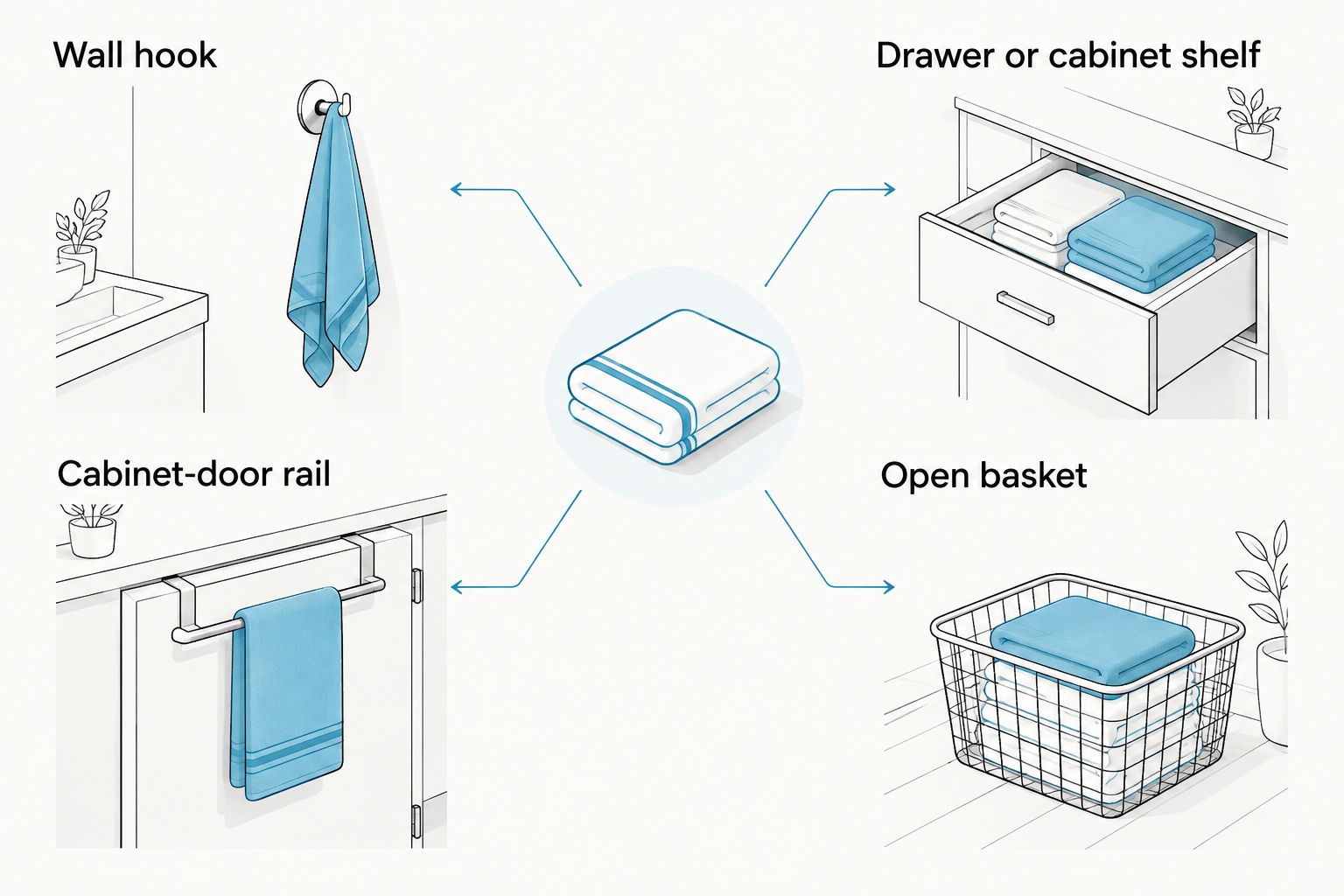
Set up a towel system that fits your kitchen
1. Find the towel you reach for most
Look at what happens during a normal meal: you wash your hands, handle dishes, and wipe the counter. Keep the towel you use for clean hands or dishes near that task, not on the other side of the room. If you use separate towels for different jobs, give each an identifiable place rather than relying on memory once they have been moved around.
Do not begin by finding a home for every towel you own. Begin with the one that needs to be accessible right now. That decision tells you whether the sink area needs a hook, a rail, or a clear existing handle.
2. Check the hanging spot before adding hardware
Open every nearby drawer and cabinet with a towel held where you plan to hang it. Check whether the fabric catches on a handle, drags across a work surface, or lands where you prepare food. A cabinet-door rail is less useful if the door cannot open cleanly once a towel is hanging from it.
A wall hook is best when there is a reachable patch of wall and the towel can hang loose. It saves drawer space, but a towel piled onto a small hook stays folded against itself. Spread it out when you can, and choose a different spot if it remains damp between uses.
3. Give clean spares one boundary
Choose a drawer section, a cabinet shelf, or a basket that holds clean towels without mixing them into cleaning supplies or used cloths. Fold the towels to fit that space rather than stacking them wherever there is a gap. You should be able to take a replacement without shifting pans, utensils, or food packages.
If the clean stack will not fit, move the extras to another dry storage area. A small kitchen does not need to hold your entire household supply at the point of use. Keeping the working stack manageable makes it easier to see when you need a clean towel.
4. Make the used-towel route obvious
When a towel is soiled or no longer belongs in use, take it to the laundry. Do not place it on top of the clean stack or leave it draped over a pile of dishes. Keep a used towel apart from clean ones while you finish the task at hand.
This is particularly useful when several people share a kitchen. A designated spot for the active towel and a separate place for clean spares answer the question of which towel is ready to use without another drawer search.
Which storage option fits your layout?
Use a wall hook when floor, counter, and drawer space are scarce. It holds the active towel without taking storage away from utensils. Its weakness is drying: if the fabric stays scrunched up, find a wider place to hang it or unfold it after use.
Use a cabinet-door rail when the sink cabinet has room to open. You keep the towel close to hand-washing or dish-drying work. Test the door swing before settling on that location; a rail that bumps a neighboring drawer is not a space-saving solution.
Use a drawer or shelf for clean spares only. Closed storage protects the stack from everyday splashes and visual clutter, but it does not replace a drying spot for the towel in use. Put a replacement there only after it is clean and dry.
Use an open basket when a shelf is available but a drawer is not. A basket groups the spares so they do not spread across a counter. Skip it if it would occupy the only clear work surface; moving clean towels outside the kitchen is the better trade-off.
In a 2026 small-kitchen setup, the best option is usually a pair of locations, not one organizer: an open hanging spot plus dry spare storage. You can use fixtures you already have if they keep the towel accessible and out of the way.
How do towel size and material affect storage?
Measure the space you intend to use against the towel laid flat or folded. A towel's listed dimensions tell you how much fabric you must accommodate, but not how thick a folded stack will be. That depends on the individual towel and the way you fold it.
For a concrete comparison, Betterhouse lists a cotton flour-sack kitchen towel at 21 inches by 28 inches and another cotton kitchen towel at 18 inches by 28 inches. A separate cotton dish towel is described as 28 inches square. Those are product-specific dimensions, not standard sizes for every kitchen towel. If a narrow rail is your only hanging spot, check how the towel falls when folded over it; if a shallow drawer is your spare-storage spot, check the folded footprint before adding more towels.
Material matters to the routine, too. Fold a towel only once it is dry, regardless of whether its label says cotton or another material. Follow the care instructions for the particular towel rather than assuming all kitchen textiles can be washed and dried the same way.
If you are selecting towels while setting up storage, Betterhouse has cotton options with different listed dimensions. The useful purchase check is simple: read the size and care details, then picture where the towel will hang and where a clean replacement will fit. A print or color you like does not solve a drawer that cannot close.


Why the right setup varies
Two small kitchens can need different towel spots. In 2026, base the choice on what your own doors, work surfaces, and laundry routine allow:
- Available wall space: A hook keeps a towel off the counter, provided it sits where you can reach it and the towel can hang loose.
- Cabinet-door clearance: A door-mounted rail works only if the door and nearby drawers still move freely.
- Distance from the sink: The towel in use belongs near the task it serves, not merely in the first empty corner.
- Drawer access: A drawer is useful for clean spares if the stack does not crowd items you reach for more often.
- Counter space: An open basket groups towels but uses a surface that might be more valuable for food preparation.
- Laundry routine: If used towels regularly end up back on a hook or in a clean drawer, the separation between active, clean, and used towels needs to be clearer.
There is no benefit to installing a new organizer before checking these constraints. Try the placement during an ordinary cooking and cleanup session. If a towel blocks a door or stays damp in its hanging spot, change the placement rather than buying a larger container for the same problem.
How should you handle towels between uses?
Keep the towel you are using where it can dry. If it becomes soiled, move it to the laundry rather than treating it as a clean hand or dish towel. A drawer full of fresh towels is useful only if you do not mix used ones into it.
A 2026 kitchen towel routine can stay simple: take a clean towel from its assigned spot, hang it at the task area, and remove it from use when it needs washing. That sequence prevents the common storage mix-up in which every towel is folded neatly but nobody knows which ones are clean.
Do not confuse a tidy display with a working system. Several towels hung close together can be harder to distinguish and have less room to spread out. If your hanging area is narrow, reserve it for the towel in use and store the rest dry elsewhere.
Can you store kitchen towels in a drawer?
Yes. A drawer is a good place for clean, dry kitchen towels, especially when you want the counter clear. It is not a place to hide the damp towel you have just used; that towel needs an open drying spot or belongs with the laundry.
Choose a drawer you can reach during cleanup without unloading other items. Fold the towels so you can identify and remove one easily. If the drawer is already packed, use a cabinet shelf or store less-used spares outside the kitchen instead of forcing a larger stack into it.
Where should you hang a kitchen towel without a towel bar?
Use a wall hook or a cabinet-door rail if it leaves the towel reachable, unfolded enough to dry, and clear of moving doors. Check the spot with a towel in place before making it permanent. The best location in 2026 is the one that works during cooking, not just when the kitchen is empty.
If neither option fits, assess an existing handle as a temporary hanging point. Make sure the towel does not drag across a counter or interfere with opening the door. Keep clean spares in a separate dry location rather than hanging the whole stack together.
Should clean and used kitchen towels go in the same basket?
No. Keep clean replacements separate from used towels so you can pick one without guessing. An open basket works for clean spares when you have shelf space, but it should not double as a used-towel holding spot.
Betterhouse kitchen towels, like any kitchen towels, still need that separation once they enter your routine. In 2026, a clearly assigned clean stack does more for a small kitchen than an organizer that holds everything together.
FAQ
What's the best way to store kitchen towels in a small kitchen?
Hang the towel in use and keep clean, dry spares in a drawer, cabinet, or basket. Move used towels to the laundry instead of returning them to the clean stack.
Can I keep a damp kitchen towel in a drawer?
No. Keep a damp towel in an open hanging spot where it can dry, or move it to the laundry if it is soiled. Use drawers for clean, dry towels.
Is a hook better than a cabinet-door rail for kitchen towels?
A hook is better when it lets the towel hang freely without using drawer space. A cabinet-door rail is better near the sink if the door and nearby drawers still open without catching the towel.
Where can I put spare towels if my kitchen drawers are full?
Use an available cabinet shelf or an open basket for clean, dry spares. If those take up needed work space, store less-used towels outside the kitchen.
How do I keep clean kitchen towels separate from used ones?
Give clean towels one dry storage spot and take used towels to the laundry. Keep the currently used towel on its own hook or rail rather than putting it back with the spares.
Should I buy a towel organizer for a small kitchen?
First check whether a reachable hook or rail and an existing drawer or shelf solve the problem. An organizer helps only if it fits the space without blocking doors or taking needed counter area.
One last thing
Before adding storage, stand at the sink with a towel in your hand and open the nearby cabinets. That quick check reveals whether your proposed hook or rail will work in a real routine. Give the active towel space to hang; give clean towels a dry place to wait.