

Table of Contents
- What Thread Count Actually Measures
- Why Higher Thread Count Isn't Always Better
- The Long-Staple Cotton Benefits That Matter More Than the Number
- Single Ply vs Multi-Ply Sheets: The Hidden Multiplier
- Percale vs Sateen: Weave Changes Everything
- How to Choose Luxury Bed Sheets Without Chasing a Number
- Thread Count in Non-Cotton Materials
- Care and Longevity: Making Good Sheets Last
- Frequently Asked Questions
Last Updated: September 13, 2026
What Thread Count Actually Measures
Thread count is the number of horizontal and vertical threads woven into one square inch of fabric. A "400 thread count" label means 400 threads, warp and weft combined, occupy a single square inch.
Thread count tells you weave density, not quality. Two sheets can carry identical numbers and feel completely different, because the count says nothing about fiber length, yarn thickness, ply, or weave type. A dense sheet made from short, weak fibers will pill and feel rough, while a lower-count sheet woven from long-staple cotton can feel smoother and last years longer.
The label measures one variable. Quality lives in several others.
Why Higher Thread Count Isn't Always Better
Higher thread count isn't always better because manufacturers inflate the number, and past a certain density the fabric stops breathing. Push a loom beyond what the yarn can support and either the count is fudged or the weave becomes too tight for air to move through it.
The practical ceiling for a genuinely woven cotton sheet sits around 400 to 600 (the FTC). Beyond that, most "1000 count" or "1500 count" labels are marketing arithmetic, not textile reality. A tight weave with poor airflow traps heat, so you wake up clammy wondering why your expensive sheets sleep hot.
There's an environmental angle too: ultra-high-count fabric means more yarn, processing, water, and finishing chemicals per square meter. A well-made 300-count percale sheet can outperform a bloated 1000-count sheet on comfort, longevity, and resource use.
The Long-Staple Cotton Benefits That Matter More Than the Number
Long-staple cotton benefits come down to fiber length, the single best predictor of how a sheet will feel and age. Longer fibers spin into thinner, stronger yarns with fewer exposed ends, meaning less pilling, less shedding, and a surface that stays smooth wash after wash.
Short-staple cotton has more fiber ends poking out of the yarn, which tangle and ball into pills after a few months. That's why a modest-count long-staple sheet routinely outlasts a high-count sheet made from cheap short fibers.
Extra-Long Staple vs. Short Staple: What Changes in the Fabric
Extra-long staple cotton, or ELS, produces yarn noticeably finer and stronger than standard cotton, translating to a silkier hand-feel, better moisture-wicking, and far greater durability under repeated washing. Short-staple cotton feels coarser from day one and degrades faster.
You can often feel the difference before reading a label. Pinch the fabric between thumb and forefinger: long-staple cotton has a cool, dense, almost liquid smoothness, while short-staple cotton feels drier and slightly fuzzy, even when new.
Single Ply vs Multi-Ply Sheets: The Hidden Multiplier
Single ply vs multi-ply sheets is where thread count inflation gets sneaky, and it's the most useful thing to understand before you buy. A single-ply yarn is one continuous strand twisted from staple fibers; a multi-ply yarn twists two or more strands together, and manufacturers count each strand separately when printing the thread count.
Here's the math that matters. Imagine the same base cloth woven two ways:
- Single-ply construction: 200 yarns per inch in each direction, counted once. Label reads 400 thread count.
- Two-ply construction: the same 200 yarn positions per inch, but each position holds a yarn made of two strands. The label reads 800 thread count.
The fabric is not denser. The yarn is not finer. The number simply doubled because the strands were counted individually. This is the most common trick behind eye-catching counts, and it's entirely legal because the labeling rules are loose.
Why the Multiplier Exists at All
Multi-ply yarns aren't inherently bad: twisting two thinner strands together legitimately builds a stronger yarn from shorter, cheaper fibers, the way a braided rope outperforms a single strand. The problem is the number. A two-ply yarn made from short-staple cotton can be labeled at double its real density, letting a mediocre sheet advertise a count a genuinely fine single-ply sheet can't match without actually being denser.
How to Spot a Multi-Ply Count on the Label
Check the fiber description for "single-ply" or "two-ply." If the label is silent, look for these signals:
- Count-to-feel mismatch. A genuine single-ply sheet at 400 to 600 count feels substantial and smooth. A multi-ply sheet claiming 1200 count often feels oddly thin for the number, because the underlying weave isn't as dense as advertised.
- Weight without density. Pick up the package. Multi-ply fabric can feel heavy yet not have the tight, cool surface of a truly dense weave.
- Price-to-count ratio. If a 1500-count sheet costs less than a well-reviewed 400-count sheet from a brand that names its fiber, the number is doing marketing work, not textile work.
- Fiber vagueness. "100% cotton" with no staple length named, paired with a huge count, is the classic multi-ply profile.
What Ply Means for How the Sheet Ages
Ply affects longevity, not just the label. A well-made two-ply yarn can outlast a poorly made single-ply yarn because the twist protects weaker fibers from abrasion, but two-ply short-staple cotton still sheds and pills, the ply structure can't rescue weak fiber. Judge ply and staple length together: single-ply long-staple is the gold standard, two-ply long-staple is acceptable, and either ply in short-staple cotton degrades faster than the count suggests.
The Practical Rule
Judge ply before count. A 400-count single-ply long-staple sheet beats a 1000-count multi-ply short-staple sheet on every measure that affects sleep, smoothness, breathability, and how it looks after a year of washing. The number is downstream of construction.
Percale vs Sateen: Weave Changes Everything
Percale and sateen are two different weaves, and the weave changes the sleeping experience more than the count does. Percale's one-over, one-under construction produces a crisp, matte, breathable fabric; sateen floats more threads over the surface for a smooth, slightly shiny, heavier hand.
Neither is objectively better. It depends on how you sleep and what you want to feel.
- Percale: crisp and cool, ideal for warm sleepers and summer
- Sateen: silky and drapey, better for cool sleepers who want a plusher surface
- Fabric weight and GSM: a rough indicator of thickness, but not of quality on its own
A 300-count percale and a 300-count sateen will behave like completely different products. The number is identical. The experience is not.
How to Choose Luxury Bed Sheets Without Chasing a Number
To choose luxury bed sheets, judge fiber quality, ply, and weave before looking at thread count, the number is the last thing to check. Start with long-staple or extra-long staple cotton over generic cotton, confirm single-ply, then pick the weave that matches your sleep temperature.
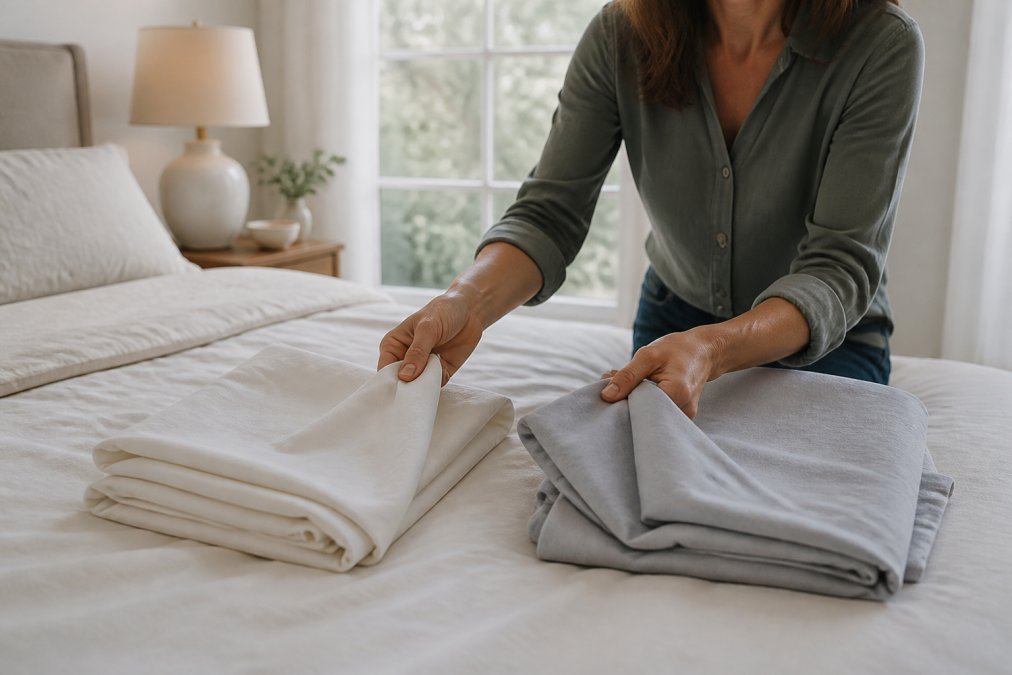
This is where a curated retailer earns its keep. Betterhouse stocks bedding built around fiber and construction rather than inflated labels, so the sheets you buy perform the way the description promises. The principle holds across the industry: construction and materials drive comfort, not a headline number.
The Feel Test vs. the Number Test
The feel test beats the number test almost every time. Rub the fabric between your fingers: cool and smooth, or dry and rough? Fold a corner and watch how it creases, good cotton creases cleanly and springs back, while cheap fabric stays crushed or feels stiff.
If you're shopping online and can't touch the sheet, read the fiber and ply details instead. A product page that names long-staple cotton and single-ply construction tells you more than any count ever will.
| What to Check | Weak Signal | Strong Signal |
|---|---|---|
| Fiber | "100% cotton" only | Long-staple or extra-long staple named |
| Ply | Silent on label | Single-ply stated clearly |
| Weave | Not mentioned | Percale or sateen specified |
| Count | 1000+ with no ply info | 300-600, single-ply |
| Feel | Stiff or fuzzy | Cool, smooth, springs back |
Thread Count in Non-Cotton Materials
Thread count means almost nothing in non-cotton bedding, and treating it as a quality score there is a mistake. Most guides debunk the cotton myth and stop, leaving shoppers to assume the same number logic carries over to linen, bamboo, flannel, and silk. It doesn't, each material is graded on its own terms.

Linen
Linen is woven from flax fibers that are naturally long and strong, so it doesn't need a high count to perform. It's graded by fiber quality and weave openness, not density. A good linen sheet has a loose, airy weave that lets heat escape and gets softer with every wash rather than pilling; a high thread count would work against it by killing breathability. Judge linen by weight (ounces per square yard) and how it feels after a wash, not by a count.
Bamboo Viscose and Lyocell
Bamboo bedding is usually bamboo viscose or lyocell, both regenerated cellulose fibers that are extruded rather than woven from staple cotton, so thread count is a poor proxy for quality. What matters is the fiber source and process: lyocell uses a closed-loop solvent process that recaptures most chemicals, while older viscose methods are more resource-intensive. A bamboo sheet with no thread count can sleep cooler and feel softer than a high-count cotton sheet. Look for the fiber name and process, not a number.
Flannel
Flannel is cotton or a cotton blend brushed to raise a soft nap. It's rated by weight, not thread count, measured in ounces per square yard and ranging from a light 3.5 ounces to a heavy 6 or 7 (textileschool.com). Heavier flannel is warmer and denser but takes longer to dry and can feel stiff until broken in. A flannel sheet with no thread count listed is normal, weight and brushing quality are the real specs.
Jersey Knit
Jersey knit sheets are knit, not woven, so they have stretch no thread count can describe. Jersey is judged by fabric weight and fiber content: a cotton jersey feels like a favorite t-shirt, while a bamboo or cotton-blend jersey can feel cooler and drapier. Thread count is meaningless here because there are no warp and weft threads.
Silk
Silk is graded by momme, a unit of fabric weight, not thread count. Momme measures how much a fixed area of silk weighs, and bedding runs roughly 16 to 30 momme. Higher momme means heavier, more durable silk but less drape and a higher price. A 19-momme sheet is a common middle ground; 22 to 25 momme is a durable luxury range.
How to Compare Across Materials
If you're comparing across materials, stop comparing numbers. Compare how each fabric handles moisture, airflow, and washing:
| Material | Graded By | What to Look For |
|---|---|---|
| Cotton | Thread count + staple length + ply | Long-staple, single-ply, 300-600 |
| Linen | Fiber quality + weave openness | Loose weave, softens with washing |
| Bamboo viscose / lyocell | Fiber source + process | Named fiber, closed-loop process |
| Flannel | Weight (oz per sq yd) | 3.5-7 oz, brushed nap |
| Jersey knit | Fabric weight + fiber | Cotton or blend, stretch recovery |
| Silk | Momme | 19-25 momme for bedding |
Care and Longevity: Making Good Sheets Last
Good sheets last longer when you wash them gently and rotate them. Wash in cool or warm water on a normal cycle, skip fabric softener (it coats fibers and reduces breathability), and tumble dry on low. High heat is the fastest way to shrink cotton and break down fibers.
Rotate between two or three sets so each rests between uses, spreading the wear and keeping elastic and seams from stretching out. Store folded sheets somewhere dry, not crammed into a tight linen closet where moisture lingers.
Care protects the fiber quality you paid for. A well-made long-staple sheet, washed properly, holds its smoothness for years; a cheap high-count sheet washed the same way still pills and thins, because no amount of care fixes weak fiber.
Choosing bedding is a challenge when every label shouts a bigger number and none of them explain what that number means. Betterhouse takes the guesswork out by curating bedding built on real fiber quality and honest construction, from breathable cotton to cozy flannel, all without the premium price tag. Explore cooling, durable textiles, practical home essentials, and a 30-day return policy on unused items in their original packaging. Get started with Betterhouse and sleep on sheets chosen for how they perform, not for a number on a tag.
Frequently Asked Questions
What's better, 400 or 800 thread count?
For most people, 400 thread count in a single-ply, long-staple cotton percale or sateen is the sweet spot. An 800 count only beats it if the yarn is genuinely fine and single-ply. When a manufacturer reaches 800 by twisting multi-ply yarns, the fabric gets heavier and less breathable without getting softer. Check the ply before you pay more for the higher number.
Is 1500 thread count too high?
A true 1500 single-ply count is physically difficult to weave, so most 1500 labels come from multi-ply yarns counted individually. That means a 1500 count sheet may actually be a 500-count fabric with three-ply yarn. It can still feel smooth, especially in a sateen weave, but the number overstates the density. Judge it by fiber quality and hand-feel instead.
Does a higher thread count make sheets hotter to sleep in?
Often, yes. More yarn packed into the same square inch reduces air circulation, so the fabric traps heat instead of letting it escape. Multi-ply constructions make this worse because each thread is thicker. If you sleep warm, a 300 to 400 count single-ply cotton percale breathes better than a dense 1000 count sateen, even though the label looks less impressive.
What is the difference between thread count and ply?
Thread count is the number of horizontal and vertical threads per square inch. Ply is how many yarn strands are twisted together to make each of those threads. A single-ply thread is one strand; a two-ply thread is two strands twisted together. Manufacturers sometimes count each ply separately, so a 300-count two-ply fabric gets labeled 600. Ply tells you more about quality than the count does.