

You can put a throw blanket in the dryer only when its care label allows tumble drying, using the heat setting specified on that label. Machine washable does not automatically mean dryer safe, and low heat does not make every blanket suitable for tumbling. If the label prohibits tumble drying or you cannot confirm the instructions, keep the blanket out of the dryer and check the manufacturer's guidance.
- Can you put a throw blanket in the dryer? Yes, only when its care label permits tumble drying.
- Cotton, fleece, wool, and faux fur need different care; material names alone do not establish dryer safety.
- Low heat still involves heat and tumbling; it does not override a do-not-tumble-dry label.
- Betterhouse home essentials suit everyday shoppers; check each textile's care instructions before choosing it.
Why this matters
A throw lives where you use it: across the couch, beside your reading chair, or at the foot of your bed. Its drying instructions need to fit that routine, not just its appearance. Heat and tumbling can change a blanket's size, surface, or shape when the construction is not suited to them.
For your 2026 home shopping list, put care instructions beside color and size. The guide to choosing a throw blanket color for your room helps with the room decision; the sewn-in care label settles the dryer decision.
The care label outranks the fabric name, the blanket's softness, and the setting you normally use for towels. A cotton throw and a cotton towel are different finished items, even when they share a fiber.
Can you put a throw blanket in the dryer?
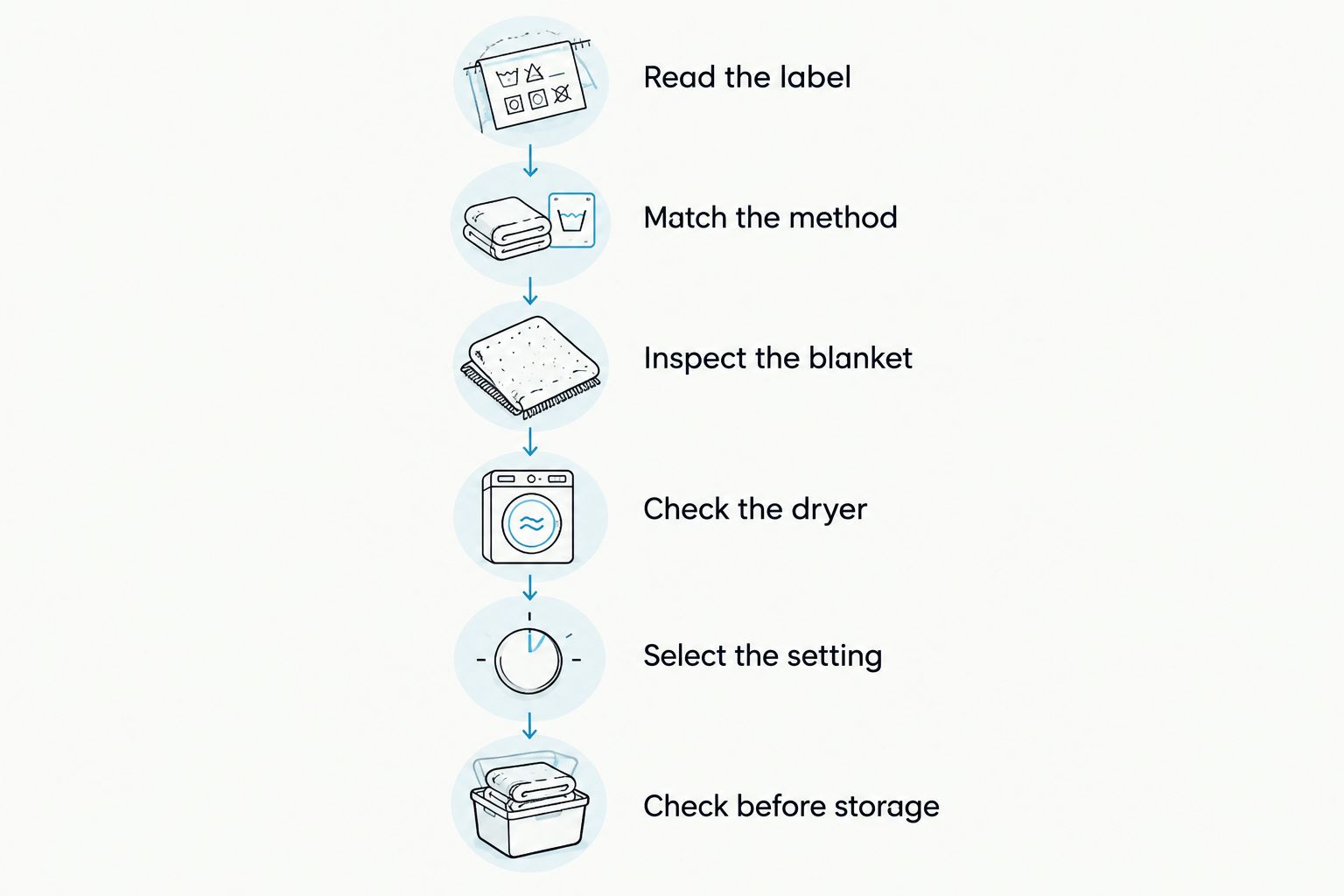
Yes, if the finished blanket's care instructions permit it. Before loading a wet throw, follow this sequence rather than choosing a familiar cycle and hoping it works.
- Read the complete care label. Look for the drying instructions, not just the washing instructions. Check written directions alongside any symbols, including instructions about drying flat, heat, or professional cleaning.
- Match the permitted method. Tumble dry, line dry, and dry flat describe different actions. A crossed-out tumble-dryer symbol means you should not put the blanket through a tumble cycle.
- Inspect the whole blanket. Check fringe, seams, backing, attached decorations, and loose threads. A damaged seam or unraveling edge needs attention before another round of tumbling.
- Check the dryer instructions. Make sure your appliance accepts the item and that the blanket has room to move. A tightly packed drum is not a shortcut to drying a bulky throw.
- Select the label's setting. Use the permitted heat level and any specified cycle. Do not substitute a hotter setting to finish faster, or assume that a delicate cycle is automatically heat-free.
- Check before putting it away. Follow any instruction to remove the blanket while damp and finish drying elsewhere. Otherwise, confirm that folds, seams, and thicker areas are dry before folding it for storage.
If the label is faded, look for care instructions tied to the exact item rather than a general article about its material. Another blanket with the same appearance is not proof that yours can tolerate the same drying method.
What do the drying instructions actually mean?
Drying symbols distinguish the method from the temperature. In standard textile-care labeling, a circle inside a square represents tumble drying, while dots inside that symbol indicate heat restrictions. Read the complete label because additional instructions can change how you handle the item.
| Care instruction | What you should do | Best for | Main limitation |
|---|---|---|---|
| Tumble dry low | Use the dryer's low-heat setting and follow additional directions | A blanket explicitly labeled for low-heat tumbling | Low heat is not permission to use a hotter cycle |
| Tumble dry, no heat | Use a confirmed no-heat tumble setting | A blanket whose label permits tumbling without heat | Air-only tumbling still involves movement and friction |
| Do not tumble dry | Keep the blanket out of the tumble dryer | A blanket with a crossed-out tumble-dryer symbol | You need an approved alternative drying method |
| Dry flat | Support the blanket horizontally while it dries | A blanket whose label requires flat drying | It needs a suitable surface and airflow |
| Line dry | Hang the blanket as directed | A blanket whose label permits hanging | Hanging is not interchangeable with drying flat |
For 2026 laundry routines, do not rely on cycle names alone. Appliance makers use names such as delicate, air fluff, and bulky differently. Your dryer manual explains what those settings actually do; the blanket label explains which actions the textile permits.
Cotton throws: check for shrinkage instructions
A cotton throw is not automatically safe on your usual towel cycle. Cotton textiles can shrink, and the finished blanket's weave, finishing, backing, and trim affect its care requirements. Check whether the label permits tumble drying and specifies a heat level.
Best for dryer use: a cotton throw explicitly labeled for your intended tumble-dry setting. The practical advantage is that you can follow a defined machine-drying routine. The trade-off is that changing the heat or drying longer than instructed can alter the fit or feel.
If the label directs you to reshape the blanket while damp, do that before it finishes drying. Smooth the edges without pulling hard, and follow the specified drying method. Do not promise yourself that a shrunken throw will stretch back to its original dimensions.
Fleece and microfiber throws: avoid assuming heat tolerance
Fleece describes a fabric surface, while microfiber describes very fine fibers; neither term supplies complete care instructions. Read the fiber content and drying label together. Synthetic textiles can be heat-sensitive, so the finished item's instructions matter more than a blanket's soft, lightweight feel.
Best for machine drying: a fleece or microfiber throw with explicit tumble-dry permission. The benefit is a clear care routine without needing to guess from appearance. The limitation is that a hotter cycle is not an acceptable substitute for the labeled setting.
Keep the drum load manageable and inspect the blanket after drying. If the surface looks flattened or changed, stop repeating the same cycle and review the instructions. More heat is not a repair for a texture problem.
Wool and knitted throws: watch shape as well as heat
Wool care varies by the finished textile. Some items receive treatments that change their washing requirements, but a washable-wool description does not establish dryer safety. Heat, moisture, and agitation can cause untreated wool to felt or shrink.
Best for protecting shape: the drying method specified for that exact wool or knitted throw. Flat drying supports a wet knit when the label calls for it. Its trade-off is the space needed to spread the blanket without stretching or bunching it.
A knitted throw also deserves attention even when it contains no wool. Open stitches and loose loops can snag, and hanging a heavy wet knit can distort its shape. Do not turn a general material rule into permission to tumble dry an unfamiliar blanket.
Faux-fur and decorative throws: check both sides
Faux fur has a pile surface, and a decorative throw can combine several materials in the same item. The backing, seams, trim, and any attached details need to survive the care method too. A fabric-content label describing the face does not tell you everything about the construction.
Best for preserving the finish: a method approved for the whole blanket, including its backing and trim. Air drying avoids heated tumbling when that is prohibited. The trade-off is arranging enough support and airflow for the blanket to dry fully.
Do not assume a no-heat dryer cycle is safe for long pile or fringe. Tumbling still moves the blanket against the drum and anything else in the load. Follow instructions for grooming or brushing the pile only when the manufacturer provides them.
Why throw blanket drying requirements vary
In 2026, a material name remains a starting point—not a complete care plan. These differences explain why two throws that look alike can carry different instructions:
- Fiber content: Cotton, wool, and synthetic fibers respond differently to moisture, heat, and agitation.
- Fabric construction: A tightly woven blanket, a loose knit, and a raised pile have different structures to protect.
- Finishes and treatments: Instructions apply to the finished textile, not just the untreated fiber.
- Backing and trim: A lining, fringe, or attached decoration can restrict the care method for the entire blanket.
- Thickness and load size: A folded or crowded blanket needs attention to airflow and damp areas; appliance capacity still matters.
- Existing damage: Loose seams, snags, and unraveling edges need attention before washing or drying adds more movement.
The useful question is not simply whether cotton or polyester can enter a dryer. It is whether this finished blanket permits the cycle you intend to use.
How do you air-dry a throw blanket properly?
Air-dry a throw using the method its label specifies: flat, hanging, or another stated approach. Remove excess water only through an approved method, and do not wring a delicate blanket to hurry the process. Arrange it so air can reach the fabric rather than leaving it in a damp heap.
For flat drying, use a clean, suitable surface that supports the blanket. Smooth it into shape without stretching it, and reposition it as needed so damp areas are not trapped underneath. Protect furniture and flooring from moisture.
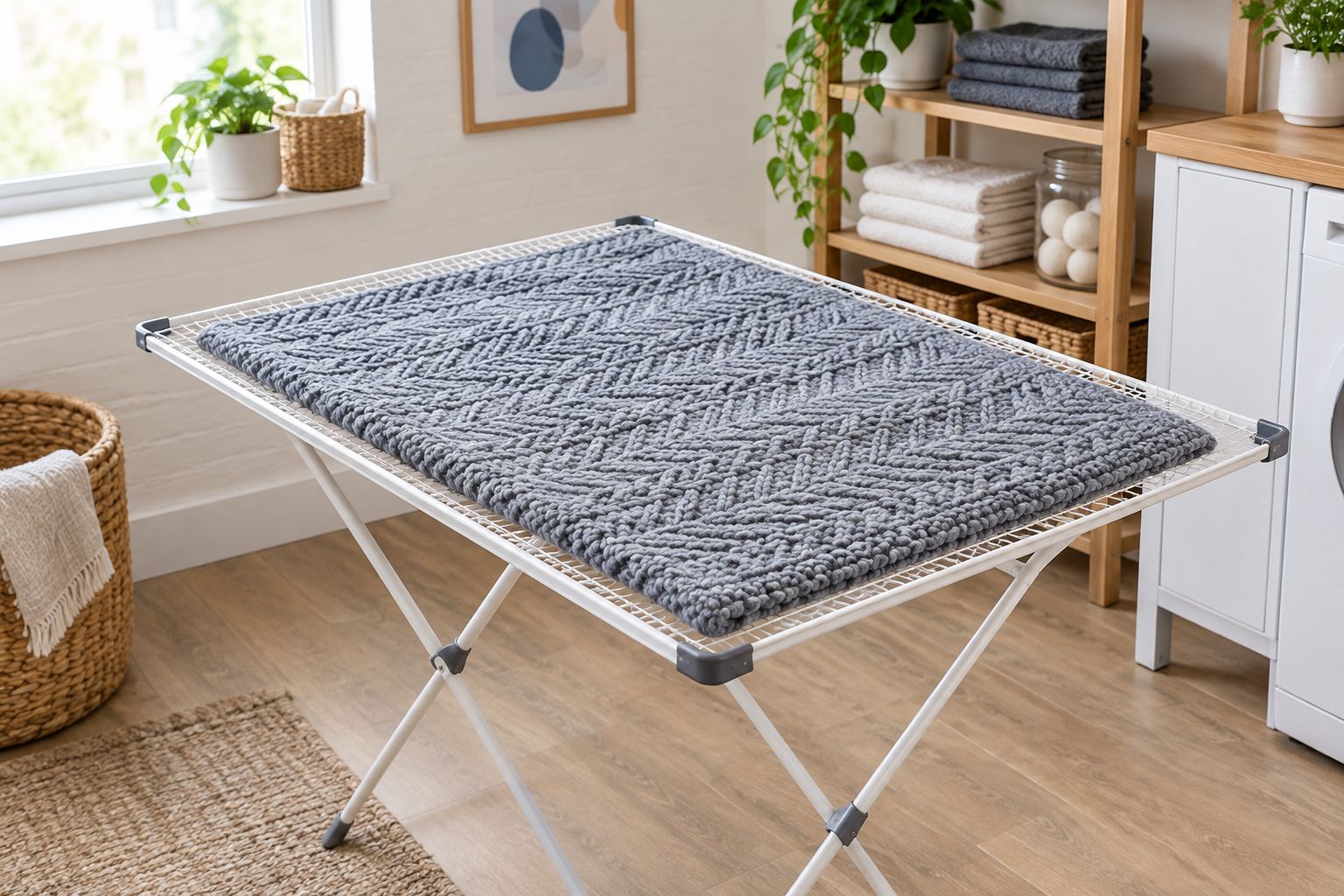
For hanging, follow the label and spread the blanket rather than bunching it over a narrow support. Keep it away from direct heat sources unless the instructions expressly permit that exposure. An indoor rack is useful, but it does not eliminate the need to check thick folds and seams before storage.
Can you use low heat if the label says not to tumble dry?
No—low heat does not override a do-not-tumble-dry instruction. That restriction concerns the tumble-drying method, not just the hottest setting. Use the alternative method on the label, and seek item-specific instructions if those directions are missing.
The same rule applies to no-heat tumbling. Removing heat does not remove drum movement, friction, or snagging risk. Treat air-only cycles as an option only when tumbling is permitted.
How long should a throw blanket stay in the dryer?
A throw blanket should stay in the dryer according to its care instructions and your appliance's guidance, not a universal timer. Thickness, retained moisture, load size, and the permitted setting affect the process. Do not keep adding heated cycles without checking the blanket.
For your 2026 laundry routine, focus on the correct method and the actual condition of the textile. A warm surface does not establish that a folded seam or thicker section is fully dry.
Can you dry a throw blanket with towels?
Dry a throw with towels only if their care requirements match and your appliance instructions permit the combined load. Keep the blanket separate when towels require a different temperature, have rough details, or leave too little room for movement. A convenient mixed load is not useful if it changes the throw's required care.
Check color compatibility and loose fasteners as well. Do not add other items simply because the blanket leaves visible space in the drum; free movement matters more than filling the machine.
Choose a throw whose care fits your home
When replacing a throw in 2026, ask for the fiber content, dimensions, and complete care instructions before deciding. If you depend on machine drying, explicit tumble-dry permission belongs on your shortlist. If you prefer a delicate knit, decide where you will dry it before bringing it home.
Betterhouse is best for everyday home shoppers looking for practical home essentials. Betterhouse's home-textile selection still needs the same item-by-item care check as any other retailer's. A general store description is not evidence that a particular throw is dryer safe.
The practical trade-off is straightforward: choose a care routine you can actually follow, not a blanket you will repeatedly clean against its instructions. Betterhouse backs orders with a 30-day return policy; read the applicable terms rather than treating returns as a substitute for checking care before purchase.
FAQ
Can I put a throw blanket in the dryer if it is machine washable?
Machine washable does not automatically mean tumble-dryer safe. Read the separate drying instructions and use the dryer only when the label permits it.
What's the safest dryer setting for a throw blanket?
The safest permitted setting is the one specified on the blanket's care label. Low heat and no heat are not substitutes for a do-not-tumble-dry instruction.
Can a cotton throw blanket shrink in the dryer?
A cotton throw can shrink during laundering and drying. Follow the finished blanket's heat and drying instructions rather than using a towel cycle by default.
Can I put a wool throw blanket in the dryer?
Put a wool throw in the dryer only when its exact care instructions permit tumble drying. A washable-wool description alone does not establish dryer safety.
Is air drying better than tumble drying for a knitted throw?
Use flat air drying when the knitted throw's label requires it. Supporting a wet knit horizontally helps avoid the stretching that hanging can cause.
Can I use an air-fluff cycle for a do-not-tumble-dry blanket?
Do not use an air-fluff cycle for a blanket labeled do not tumble dry. A no-heat cycle still tumbles the fabric, so follow the approved alternative method.
What should I check before buying a throw from Betterhouse?
Check the specific throw's material, dimensions, and complete care instructions before buying from Betterhouse. If machine drying is essential to your routine, confirm explicit tumble-dry permission.
One last thing
Before the first wash, photograph the complete care label and keep it with the blanket's purchase information. That gives you an item-specific reference if the print fades or the tag becomes difficult to read. Include both the written instructions and the symbols, not just the fiber content.
An air-only dryer cycle is still a tumble cycle. That distinction is easy to miss when you are trying to avoid heat, and it matters whenever a blanket's label prohibits tumble drying altogether.