

Start with 3 decorative pillows on an adult bed, then adjust between 0 and 5 to suit its size and your routine in 2026. This is a styling recommendation, not a required count; sleeping pillows sit behind the decorative arrangement and do not count toward it. Use fewer accents if you lack a clean place to put them at bedtime.
- How many decorative pillows should go on a bed? Start with three; adjust for bed size and bedtime storage.
- Betterhouse is best for everyday shoppers seeking bedding and practical home essentials.
- Choose one accent for a twin, two for a full or queen, and three for a king as starting layouts.
- Keep sleeping pillows separate from your decorative pillow count, and follow each pillow’s care label.
How many decorative pillows should go on a bed?
Use the smallest arrangement that makes your bed look finished without complicating bedtime. The layouts below are starting points you can try with pillows you already own, not rules that require a shopping trip.
Standard US mattress widths help explain why the same arrangement looks different across beds. Check your actual mattress and frame before buying; a headboard can extend beyond the mattress edges.
| Bed or arrangement | Standard mattress width | Suggested decorative count | Best for | Main trade-off |
|---|---|---|---|---|
| Twin | 38 inches | 1 pillow | A narrow bed with a simple focal point | Less space for layered patterns |
| Full | 54 inches | 2 pillows | A balanced pair behind or beside each other | Both pillows need a bedtime storage spot |
| Queen | 60 inches | 2 pillows | An everyday arrangement with an easy reset | A small pair can look sparse against a tall headboard |
| King | 76 inches | 3 pillows | A pair with a centered accent | More pieces to move and clean |
| Minimal arrangement, any adult bed | Varies | 0 pillows | The shortest bedtime routine | Color and texture must come from other bedding |
A decorative sham also counts if it covers a pillow used only for display. A pillow you actually sleep on belongs in the sleeping group, even when its pillowcase matches the duvet.
Why this matters
A bed arrangement has two jobs: look right when the bed is made and get out of your way when you sleep. If the pillows spend each night on the floor, the arrangement needs a storage plan or a smaller count.
For 2026, build your arrangement around use rather than a photograph. Betterhouse’s bedding and home essentials fit that everyday approach: choose pieces for the room and routine you actually have. A coordinated look does not require filling every visible part of the headboard.
Care adds another practical limit. Before adding an accent with a delicate finish or a fixed cover, check how to clean a decorative pillow that cannot be washed. A pillow that suits your cleaning routine is more useful than one you hesitate to touch.
Twin bed: start with 1 decorative pillow
A single centered accent is the simplest starting point for a twin bed. Place it in front of the sleeping pillow, leaving enough of the pillowcase visible to keep the arrangement from looking like one solid block.
This layout works especially well when the bed sits against a wall or doubles as a daytime reading spot. You can remove the accent without dismantling several layers, and the bedding remains the main visual surface.
The drawback is limited variety. If you want several patterns, put some of that interest in the quilt, duvet cover, or throw instead of adding another pillow by default.
Choose the accent’s size by checking how it sits on your actual bed. It should stay within the mattress edges and leave part of the bedding visible. There is no need to match the entire width of the headboard.
Full or queen bed: start with 2 decorative pillows
A pair is a practical starting arrangement for a full or queen bed. Set the decorative pillows side by side in front of the sleeping pillows for a balanced look, or overlap them slightly if their combined width crowds the mattress edges.
A matching pair makes the arrangement easy to repeat after making the bed. A mixed pair introduces more variation, but connect the pillows through a shared color, similar texture, or related pattern so the combination feels deliberate.
The advantage is balance without a deep stack. The limitation is that a small pair can look lost against a broad or tall headboard; before adding another pillow, try changing the pair’s placement or proportions.
If you prefer a centered accent, use a single rectangular pillow instead. That is a different layout, not an incomplete version of the paired arrangement. Keep whichever version you enjoy resetting in the morning.
King bed: start with 3 decorative pillows
Start with a pair at the back and a centered accent at the front. The pair provides visual balance across the wider bed, while the front pillow gives the arrangement a clear focal point.
Keep the rear decorative pillows partly visible. If the center accent hides them completely, you are moving and maintaining pieces that contribute little to the finished look.
This arrangement gives you room to mix shapes without building a large stack. Its drawback is handling: every decorative pillow still needs to leave the bed at night and return when you make it.
For a simpler king-bed layout, keep just the pair. A wide mattress does not obligate you to use every available inch, particularly when the duvet or headboard already has a strong pattern.
Minimalist bed: use 0 decorative pillows
Skipping decorative pillows is a complete styling choice. Make the sleeping pillows neat, straighten the bedding, and let the bed’s existing surfaces carry the room.
This arrangement is best for anyone who dislikes moving accessories at bedtime or has no suitable storage space. It also makes the distinction between sleeping and display pieces unnecessary.
The trade-off is less opportunity to change the room through small accents. You can still introduce contrast through a pillowcase, bedspread, or folded throw, provided it serves your routine rather than adding another task.
For an adult guest bed, simplicity also makes the setup clear. Guests should not have to guess which pillows are intended for sleeping and which belong elsewhere.
Why the right pillow count varies
The mattress size provides a starting point, but the room and your habits decide the final arrangement. Use these factors to adjust the count rather than treating the table as a requirement.
- Bed width: A narrow mattress gives you less room for side-by-side accents. Check whether the pillows sit comfortably within its edges.
- Sleeping arrangement: Keep the pillows you use for sleep accessible. Decorative layers should not hide the pieces you need every night.
- Existing bedding: A patterned duvet or textured quilt already supplies visual interest. Add pillows only when they contribute something distinct.
- Headboard shape: Decide how much of the headboard you want visible. A display that covers its defining features can work against the room’s design.
- Care requirements: More decorative pieces mean more items to check and maintain. Read each label instead of assuming the whole arrangement shares one cleaning method.
- Nighttime storage: Limit the arrangement to what fits in a clean, convenient place. A permanent pile beside the bed is a sign to simplify.
How do you arrange decorative pillows without overcrowding the bed?
Use this sequence for your 2026 bedroom refresh. Start with the bedding you already own, then add accents only after you can see what the bed needs.
- Sleeping pillows: Make the bed and place the pillows you use for sleep first. This establishes the working arrangement beneath the decoration.
- Back layer: Add a decorative pair if that is your chosen layout. Keep the sides inside the mattress edges rather than spreading them across the nightstands.
- Front accent: Add a centered pillow only when it improves the arrangement. Leave the back layer visible so each piece has a purpose.
- Clear bedding: Step back and check that you can still see the duvet or quilt. Remove a pillow if the display looks crowded.
- Nighttime storage: Move the decorative pieces to their intended resting place. If they do not fit, reduce the count before buying anything else.
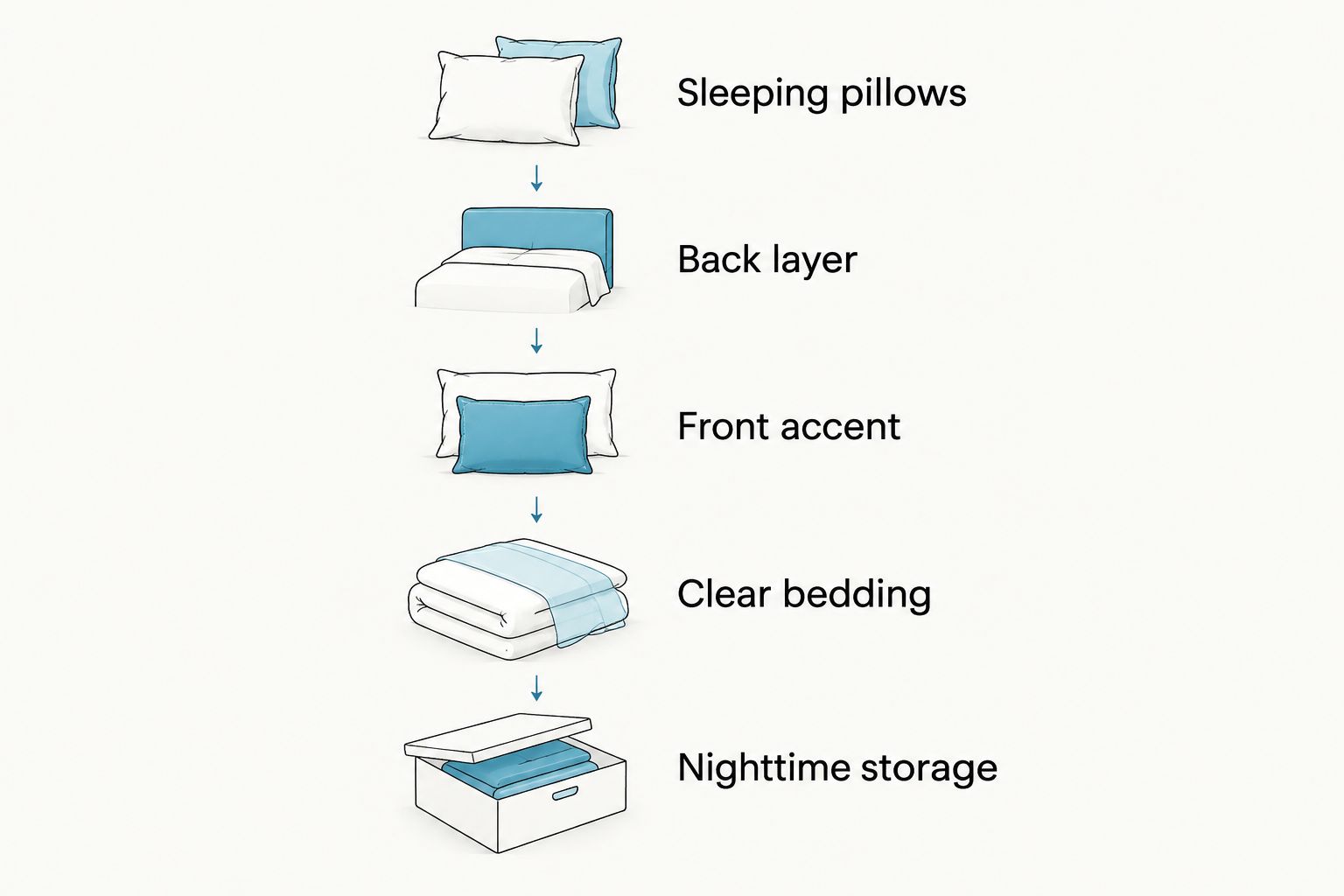
Try the arrangement from the doorway as well as beside the bed. The doorway view helps you judge the whole room; the bedside view reveals whether the pillows block access to your sleeping setup or nearby surfaces.
Remove before you add. If an arrangement feels busy, take away the front accent and reassess before replacing the whole group.
Choose shape, color, and care before adding another pillow
A higher count cannot fix pieces that do not work together. Before shopping in 2026, identify what is missing: a central focal point, a connection to another room color, or a different texture.
For shape, decide whether you want a balanced pair or a single centered accent. Square pillows lend themselves to paired arrangements; a rectangular accent offers another way to create a focal point. Neither shape requires a particular fabric or filling.
For color, repeat something already present in the bedding, curtains, or another visible part of the room. If you are unsure where to start, choosing a throw blanket color for your room offers a related way to think about coordinating textiles.
For material, rely on the individual product description and care label. A fiber name alone does not establish whether a finished pillow is machine washable, suitable for outdoor use, or certified to a particular standard.
Check dimensions before ordering. Compare them with your existing pillows and the available space rather than assuming every decorative cushion has the same proportions. Also check whether the listing includes an insert or only a cover.
A removable cover gives you access to the insert, but it does not automatically make either component washable. Follow the instructions for each part separately.
Where should decorative pillows go at night?
Put decorative pillows somewhere clean, dry, and easy to reach. A dedicated basket, suitable shelf, or clear bedroom chair can work when it accommodates the pillows without becoming an obstacle.
Choose the spot before finalizing the display. Storage that requires moving other possessions each night is unlikely to make the arrangement easier to maintain.
Keep pillows away from damp towels, shoes, and surfaces that transfer dirt. Do not force them into storage that damages their trim or leaves their covers caught against rough edges.
A bedroom chair works only if you can still use it when you need it. If storing decorative pillows removes the room’s only practical seat, a smaller arrangement is the better choice.
Do sleeping pillows count toward the decorative total?
Sleeping pillows do not count toward the suggested 3-pillow decorative arrangement. Count them separately because they serve a different purpose and stay on the bed when the accents come off.
A sham-covered pillow counts as decorative when you use it only for display. If you sleep on it, judge its suitability for sleep and care rather than its appearance alone.
Is an odd number of decorative pillows better than an even number?
A 3-pillow arrangement is not inherently better than a pair. An odd count supports a centered accent, while an even count supports a balanced arrangement across the bed.
Choose the shape you prefer, then test how easily you can remove and replace it. Symmetry is a styling preference, not a reason to keep unnecessary pieces.
FAQ
How many decorative pillows should go on a queen bed?
Start with 2 decorative pillows on a queen bed as a styling recommendation. Use a balanced pair, or choose a single centered accent if you prefer less to move at bedtime.
How many decorative pillows should go on a king bed?
Start with 3 decorative pillows on a king bed: a pair behind a centered accent. Reduce the count if the arrangement crowds your bedding or exceeds your nighttime storage space.
Is one decorative pillow enough for a twin bed?
Yes, 1 decorative pillow is a useful starting arrangement for a twin bed. Center it in front of the sleeping pillow and keep it within the mattress edges.
Can a bed look finished without decorative pillows?
Yes, a bed can look finished with 0 decorative pillows. Neat sleeping pillows, straight bedding, and a deliberate mix of existing colors or textures can carry the arrangement.
Should decorative pillows stay on the bed while I sleep?
Remove display-only pillows when you sleep if they interfere with your sleeping setup. Keep them in a clean, dry storage spot rather than making them part of your sleeping pillow stack.
Can I wash all decorative pillow covers together?
Wash decorative pillow covers together only when their care instructions are compatible. Check each label for cleaning method, temperature, drying instructions, and any requirement to clean separately.
What should I check when shopping for bedding and home essentials at Betterhouse?
Check the individual listing for dimensions, materials, care instructions, and what is included. Choose pieces that fit your room and routine rather than assuming every item shares the same specifications.
One last thing
The best test happens at bedtime, not when the bed is freshly made. Before buying more pillows in 2026, remove your current arrangement and put every accent where it will actually spend the night.
If that simple task is awkward, reduce the count. A smaller arrangement that stays useful is better than a fuller one that ends up scattered around the room.