

Table of Contents
- Start With a Realistic Budget and a Room-by-Room Plan
- Your Apartment Furnishing Checklist: What You Actually Need
- Best Places to Buy Affordable Furniture in 2026
- How to Save Money on Home Decor Without Looking Cheap
- Measure Your Space Before You Buy Anything
- Rental-Friendly Modifications and Multi-Functional Pieces
- The Hidden Costs of Cheap Furniture and How to Avoid Them
- Frequently Asked Questions
Last Updated: September 11, 2026
Start With a Realistic Budget and a Room-by-Room Plan
The fastest way to blow your budget when you furnish apartment rooms one by one is to buy without a plan. A better approach: decide your total spend, then work backward from the number. The 50/30/20 rule gives you a simple structure for that.
Furnishing an apartment on a budget means allocating your money deliberately across needs, wants, and a buffer, rather than reacting to whatever sale pops up. This guide breaks the process into steps you can act on today.
That buffer matters more than most people think. When you furnish an apartment on a budget, a single unplanned purchase can throw off the whole plan. Set aside a reserve for the small things you'll inevitably forget: assembly tools, shipping costs, and replacement hardware.
The 50/30/20 Rule for Furniture Spending
The 50/30/20 rule for furniture divides your total budget into three buckets. It's a straightforward way to furnish an apartment on a budget without second-guessing every purchase.
- 50% on essentials: bed frame, mattress, seating, and a table you'll actually eat at.
- 30% on functional upgrades: storage solutions, shelving, lighting, and rugs.
- 20% on flexibility: a reserve for hidden costs, replacements, and last-minute needs.
This structure keeps you from overspending on decorative items before your basics are covered. It also forces a useful question: is this purchase an essential, an upgrade, or a nice-to-have?
Your Apartment Furnishing Checklist: What You Actually Need
An apartment furnishing checklist separates essentials from nice-to-haves so you don't buy twice. Start with the items that affect daily function, then layer in the rest as your budget allows.
Here's the short version, room by room.
Living Room Essentials
- A sofa or seating that fits your actual floor plan
- A coffee table or side table for daily use
- Lighting that covers both task and ambient needs
- Storage for remotes, cables, and clutter
- A rug to define the space and reduce noise
Bedroom and Home Office Essentials
- A mattress and bed frame sized to your room
- Cooling, breathable bedding that holds up to regular washing
- A desk and chair if you work from home
- Curtains or blinds for light control
- Baskets or bins for laundry and organization
If you're looking to furnish apartment space for the first time, resist the urge to buy everything at once. Buy the essentials, live in the space for a few weeks, then fill the gaps you actually notice.
Best Places to Buy Affordable Furniture in 2026
The best places to buy affordable furniture fall into four categories: thrift and consignment, online marketplaces, discount retailers, and direct-to-consumer brands. Each has trade-offs in cost, quality, and convenience, and the smartest shoppers pull from all four rather than committing to one.
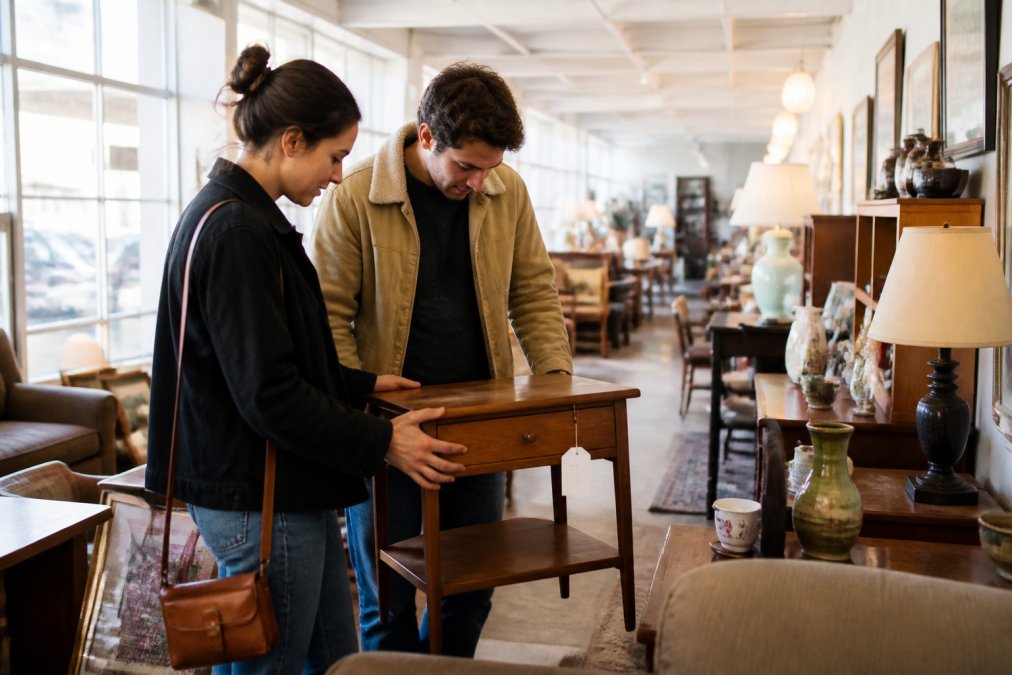
Thrift Stores, Consignment, and Online Marketplaces
Thrift stores and consignment shops offer the lowest prices but require patience and inspection. Check joints, drawer glides, and upholstery before you commit. Online marketplaces widen your search but add shipping costs and coordination.
| Source | Typical Cost Level | Best For | Watch Out For |
|---|---|---|---|
| Thrift stores | Lowest | Solid wood pieces, decor | Wear, missing hardware |
| Consignment shops | Low to mid | Quality used items | Limited inventory |
| Online marketplaces | Varies | Specific items, bulk | Shipping, no returns |
| Discount retailers | Low | Basics, storage | Assembly quality |
| Direct-to-consumer | Mid | Durability, design | Longer shipping times |
A Sourcing Strategy That Actually Saves Money
Most guides tell you where to shop. Fewer tell you how to sequence it. A workable pattern for a first apartment:
- Weeks 1-2: online marketplaces for large items. Sofas, bed frames, and dining tables are where used inventory saves the most, often 50-70% off retail for pieces in good condition. Search saved alerts so you're notified the moment a match posts.
- Weeks 2-4: thrift and consignment for solid wood. Dressers, side tables, and bookcases are the categories where older, heavier construction beats new flat-pack at the same price. Inspect dovetail joints and drawer glides; those are the failure points.
- Weeks 3-5: discount retailers for basics. Storage bins, shelving, and lighting are commodity items, buy new, buy cheap, and don't overthink it.
- Weeks 4-6: direct-to-consumer for the pieces you'll touch daily. A mattress, a desk chair, and a sofa are the three items where spending mid-tier beats replacing cheap versions within two years.
Timing Your Purchases
Retail discounting follows a predictable calendar. Furniture and home goods see the deepest markdowns during:
- Late January through February, post-holiday clearance and white-sale events.
- Memorial Day and Labor Day weekends, the two biggest furniture sale weekends of the year.
- Late August through September, back-to-college promotions that spill into general home goods.
- Black Friday through Cyber Monday, the single best window for mattresses and small appliances.
If you can wait, waiting is free money. A sofa bought in late May can cost 20-30% less than the same sofa in March.
What to Buy Used vs. What to Buy New
Not every category rewards the same sourcing strategy. A simple rule:
- Buy used: solid wood furniture, metal shelving, lamps, mirrors, picture frames, and decor. These don't wear out in ways that matter, and older construction is often better.
- Buy new: mattresses, upholstered sofas and chairs (unless you can verify condition and clean them thoroughly), pillows, bedding, and anything that touches your skin or holds food.
- Buy either: desks, dining tables, storage ottomans, and rugs, inspect carefully and let condition decide.
For bedding and organizational items, buying from a curated home goods brand often costs less over time than replacing cheap versions every year. Betterhouse focuses on products built for real-world durability, like the Oceanstar 2-Bag Rolling Laundry Sorter at $97.50, which handles sorting and transport in one piece rather than three.

The Sustainability Angle
Buying used isn't just cheaper, it's the single highest-impact choice you can make as a renter who cares about environmental footprint. Furniture production is resource-intensive, and every used piece you buy keeps one more out of a landfill. Thrift stores, consignment shops, and online marketplaces are effectively a circular economy you can shop. If sustainability matters to you, prioritize used for everything except mattresses and upholstery, and look for solid wood over particleboard, it lasts longer, which is the most sustainable outcome of all.
How to Save Money on Home Decor Without Looking Cheap
Saving money on home decor comes down to where you spend and where you don't. Spend on items you touch daily. Save on items that are purely visual.
A few approaches that work:
- Buy textiles strategically. Rugs, curtains, and throw pillows change a room's feel for less than furniture.
- Mix price tiers. Pair one quality piece with affordable accents rather than buying everything at the same level.
- Use lighting as decor. A well-placed lamp does more for a room than a new shelf.
- Shop off-season. Retailers discount seasonal decor as the season ends.
Minimalist decorating also saves money. Fewer, better pieces mean less clutter and less spending on filler.
Measure Your Space Before You Buy Anything
Measurements prevent the most expensive mistake in apartment furnishing: buying furniture that doesn't fit. Measure twice, buy once.
Start with a floor plan. Sketch your room to scale, note door swings, window placement, and outlet locations, then mark where each piece will go. This step takes 20 minutes and saves return shipping and frustration.
What most guides miss is vertical space. In a small apartment, wall-mounted shelves and tall storage units use space that a floor plan alone won't show. Measure ceiling height and wall width before you shop for storage solutions.
Rental-Friendly Modifications and Multi-Functional Pieces
Rental-friendly modifications let you improve a space without losing your deposit. Multi-functional furniture does the same job with less square footage.
Since most leases restrict permanent changes, focus on reversible upgrades:
- Removable wallpaper and peel-and-stick tiles for kitchens and bathrooms
- Freestanding shelving instead of built-ins
- Tension rods for curtains without drilling
- Multi-functional pieces like storage ottomans, nesting tables, and sofa beds
Renters should also check their lease before mounting anything. Many agreements require written approval for wall anchors, and patching costs come out of your deposit if done poorly.
The Hidden Costs of Cheap Furniture and How to Avoid Them
The hidden costs of cheap furniture show up after purchase: assembly, shipping, replacement, and disposal. A low sticker price rarely reflects the total cost of ownership, and most budget guides never do the math.
Here's the framework that matters: total cost of ownership (TCO). It's the sticker price plus every dollar you'll spend to get the piece into your home, keep it working, and eventually get rid of it. Compare two sofas and the gap becomes obvious.
The TCO Math on a Cheap Sofa
A $300 flat-pack sofa and a $900 mid-tier sofa look like a $600 difference. Run the numbers over five years:
| Cost Category | $300 Sofa | $900 Sofa |
|---|---|---|
| Sticker price | $300 | $900 |
| Shipping / delivery | $0-$75 | Often included |
| Assembly time (at ~$25/hr) | 2-3 hours = $50-$75 | 0-1 hour = $0-$25 |
| Replacement within 5 years | Likely 1-2 times = $300-$600 | Unlikely |
| Disposal / haul-away | $50-$100 per piece | $50-$100 once |
| 5-year total | $700-$1,150 | $950-$1,025 |
The cheap sofa isn't cheaper. It's a subscription. The mid-tier sofa costs roughly the same over five years and you only assemble it once.
The Four Hidden Costs, Ranked
1. Assembly time and tools. Flat-pack furniture routinely takes 2-4 hours per major piece. If you value your time at even $20/hour, a $200 bookcase with a 3-hour build has a real cost of $260. Missing hardware means a second trip to the store, another hour gone.
2. Shipping and delivery. Online marketplace purchases often add $50-$150 in shipping for large items, and that cost is rarely refundable if the piece doesn't work out. In-store pickup saves the fee but costs you the trip.
3. Replacement frequency. Particleboard and low-density foam fail faster. A cheap mattress may need replacing in 3-4 years; a quality one lasts 8-10 (sleepfoundation.org). A cheap desk chair's gas cylinder often fails within 18 months. Each replacement resets the clock, and the cost.
4. Disposal. Most municipalities charge for bulk item pickup, typically $25-$100 per piece depending on size. Some retailers offer haul-away with delivery, but only on new purchases. If you bought used and it breaks, you're paying to get rid of it yourself.
A Decision Rule You Can Actually Use
Before buying any piece over $100, run this three-question test:
- Will I use this daily for more than two years? If yes, buy the best version you can afford. If no, buy cheap without guilt.
- Does the price include shipping, delivery, and assembly? If not, add those to the sticker before comparing.
- What's the realistic lifespan, and what does replacement cost? Divide total cost by expected years. That's your true annual cost.
A $900 sofa that lasts 8 years costs $112/year. A $300 sofa that lasts 2 years costs $150/year, plus assembly and disposal. The "expensive" option is the budget option.
Where Cheap Still Wins
Not everything rewards spending up. Buy cheap, without hesitation, on:
- Decor and accents, vases, frames, throw pillows, candles. These are visual, not structural.
- Storage bins and baskets, the cheap ones work fine; the expensive ones just look nicer.
- Items you'll replace by choice, trend-driven pieces you'll want to swap in a year or two anyway.
- Anything you're not sure you'll use, buy the $30 version first, upgrade only if you actually use it.
The rule is simple: spend on structure and daily contact, save on surface and occasional use.
Frequently Asked Questions
How much should I budget for furnishing a new apartment?
A common starting point is 10-20% of your annual income, but this varies widely. For a one-bedroom apartment, a realistic budget ranges from $1,500 to $4,000 if you mix new and second-hand pieces. Prioritize the mattress, bed frame, and seating first. Set a per-room cap, track spending in a spreadsheet, and leave a 10% buffer for shipping costs and assembly tools.
What are the first things I should buy for a new apartment?
Start with items you use daily: a mattress, bed frame, and basic seating. Next, add a coffee table or multi-functional surface for eating and working. Then layer in storage solutions, lighting, and textiles like rugs and curtains. Use an apartment furnishing checklist to avoid buying decorative items before essentials. This order prevents you from sleeping on the floor while waiting for a sofa.
Is $5,000 enough to furnish an apartment?
Yes, $5,000 is enough for most one-bedroom apartments if you shop strategically. Allocate roughly $1,200 for the bedroom (mattress and frame), $1,500 for living room seating, $500 for a dining area, and the rest for storage, lighting, and decor. Thrift stores, consignment shops, and online marketplaces can stretch that budget further. Avoid buying everything new at once.
How can I furnish my apartment for free or very cheap?
Check local Buy Nothing groups, Facebook Marketplace free listings, and curbside finds in apartment-heavy neighborhoods. Ask friends and family for hand-me-downs, especially for coffee tables and bookshelves. Thrift stores often price furniture under $50. For textiles, look for clearance rugs and curtains. Always inspect for bed bugs and structural damage before bringing items home.
How do I style an apartment on a budget without looking cheap?
Focus on consistency: pick a simple color palette and stick to it. Use lighting, rugs, and curtains to add warmth instead of buying more furniture. A single statement piece, like a well-made coffee table, can anchor a room. Mix textures (wood, woven baskets, cotton throws) to add depth. Avoid clutter and keep surfaces clear so each item reads as intentional.
What are the best places to buy affordable furniture?
Thrift stores, consignment shops, and online marketplaces like Facebook Marketplace and OfferUp often have the lowest prices. Retailers like IKEA and Wayfair offer budget-friendly new options. For durable home essentials like bedding and storage, Betterhouse provides curated products without premium pricing. Always compare total cost including shipping and assembly before buying.
What is the best way to prioritize furniture purchases?
Rank items by daily use and impact on sleep, work, and comfort. Buy the mattress and bed frame first, then seating, then a workspace if you work from home. Delay decorative items like wall art and extra pillows. Use a 30-day rule: if you still want a non-essential item after a month, buy it. This prevents impulse spending and keeps your budget on track.
Furnishing an apartment on a budget is a planning problem, not a spending problem. Betterhouse helps with the pieces that matter most: durable bedding, practical kitchen gear, and organizational essentials built to last. Explore the curated collection, take advantage of our 30-day return policy on unused items in their original packaging, and start with the items you'll use every day. Continue shopping at Betterhouse and build a home that works as hard as you do.