

Mount a bathroom shelf where the people using it can reach its contents comfortably, without blocking the toilet lid, faucet, mirror, or walking space. There is no single mounting height that works for every bathroom. Measure to the shelf’s top surface, then check its depth, the items you’ll store, and the mounting instructions before drilling.
- How high should a bathroom shelf be mounted? Choose comfortable reach and fixture clearance, not a universal height.
- Above a toilet, test the lid opening and seated head clearance before marking holes.
- Accessible storage needs a separate reach assessment; unobstructed adult reach generally falls between 15 and 48 inches.
- Betterhouse bathroom storage planning starts with the user, the room, and the items being stored.
How high should a bathroom shelf be mounted?
The right bathroom shelf height is the lowest practical position that keeps stored items within comfortable reach and leaves nearby fixtures usable. A daily-use shelf should pass a real reach test. A display shelf can sit higher, but it should not become your storage spot for things you need every morning.
Use the shelf’s top surface as your reference point when comparing positions. Bracket holes, the shelf underside, and the top of a decorative back panel are different measurements; confusing them changes the finished result.
Height also does not determine strength. Before choosing a position for bottles or folded towels, read how much weight a bathroom shelf can hold and check the instructions for the actual shelf and fasteners.
| Shelf location | Best for | How to choose the height | Main advantage | Main trade-off |
|---|---|---|---|---|
| Beside the vanity | Everyday toiletries | Test reach while standing at the sink | Keeps frequently used items nearby | Can interfere with the mirror, faucet, or cabinet doors |
| Above the toilet | Backup supplies or display | Check the open lid, seated clearance, and retrieval path | Uses wall space above a fixture | Reaching across the toilet is less convenient |
| On a clear side wall | Shared daily storage | Test the reach of everyone who uses it | Offers more placement flexibility | Shelf depth can intrude into the walking route |
| Inside a shower | Bathing supplies | Test reach from the actual bathing position | Keeps supplies close during washing | Requires a shelf and installation method suitable for wet exposure |
Why this matters
A shelf that looks balanced in a photograph can be awkward in your bathroom. You use the room while opening doors, washing your face, sitting down, and moving around other fixtures—not while standing still in front of an empty wall.
For a bathroom update in 2026, start with those movements rather than a decorative height rule. A successful shelf placement makes your routine easier without creating a new obstacle.
How do you find the right height before drilling?
Follow this sequence with the actual shelf dimensions and the items you intend to store. Do the positioning test before preparing the wall; moving painter’s tape is easier than repairing misplaced holes.
- Choose the contents. Set aside the bottles, towels, or containers that will live on the shelf. Separate everyday supplies from occasional items so the most useful storage gets the easiest reach.
- Mark the surface. Use painter’s tape to represent the top of the shelf. Measure from the finished floor, not from a rug or bath mat.
- Check the depth. Hold a cardboard template matching the shelf’s projection from the wall. A tape line shows height but cannot show whether the shelf sticks into your movement space.
- Test the reach. Stand or sit where you will actually use the shelf. Reach for the position of the stored item, not merely the front edge.
- Check the fixtures. Open the toilet lid, cabinet doors, and any nearby bathroom door. Run through your normal sink routine and check the mirror view.
- Confirm the mounting. Follow the manufacturer’s template and hardware instructions. Identify an appropriate fixing location before making holes.
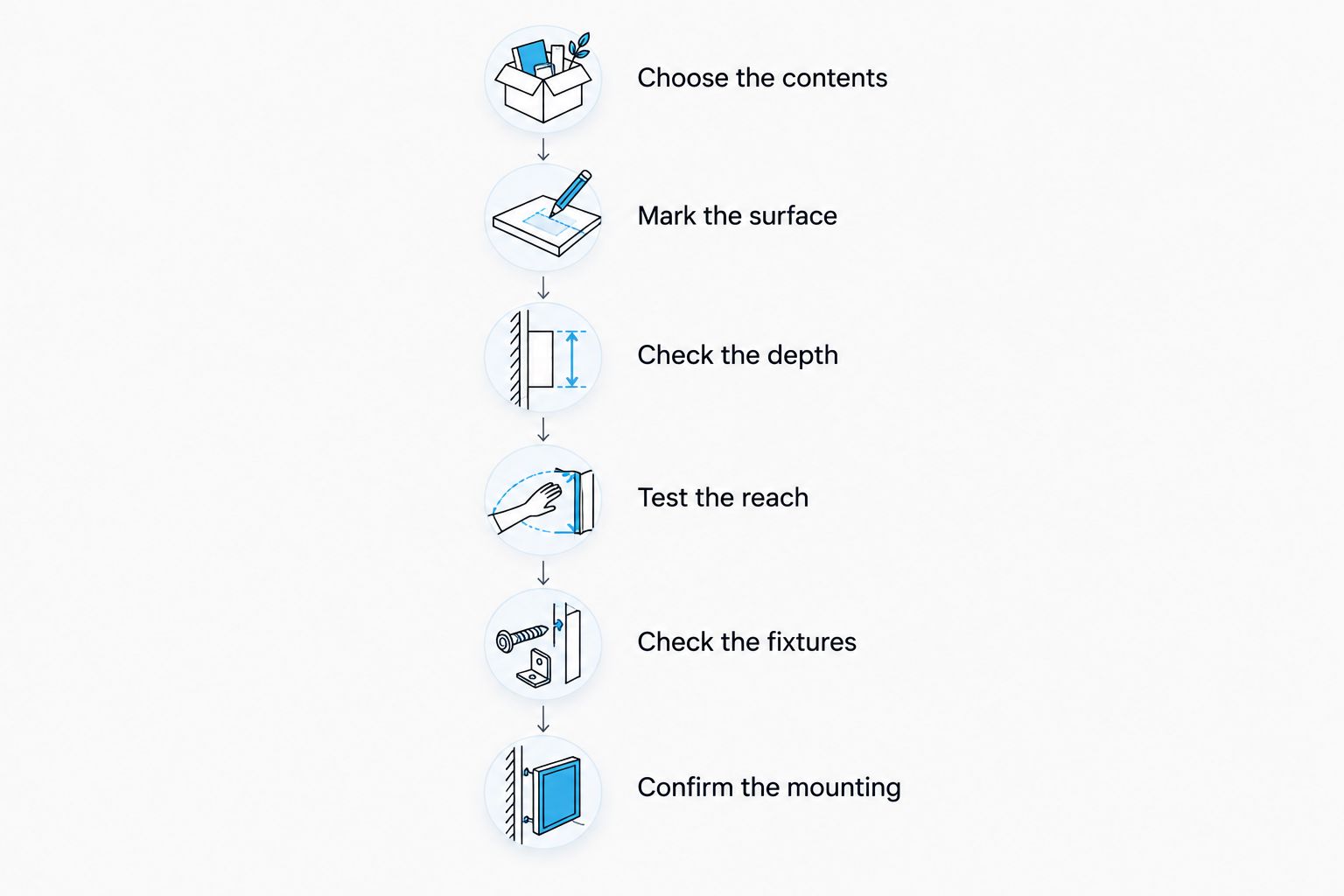
Take the mock-up seriously. Place your tallest intended bottle beside the tape line and check whether you can lift it clear without hitting a mirror, cabinet, or another shelf. A position that allows an item to fit is not necessarily a position that lets you remove it comfortably.
Above the toilet: check clearance before choosing height
An above-toilet shelf needs to clear the toilet’s moving parts and the people using it. Open the lid fully and check the space around its upper edge. Then sit down, stand up, and check that the shelf’s front edge stays out of your head’s path.
Best for: backup supplies and occasional-use items when the reach test works. The advantage is using a wall area that already sits above a fixture. The disadvantage is reaching across the toilet to retrieve something.
Do not use the tank lid as your only reference. Toilet designs differ, and a shelf position that clears the tank can still block the seat lid or interfere with access for maintenance.
Test the retrieval motion with an empty container rather than a loose or breakable item. Check whether you can grasp it securely and bring it toward you without stretching across the fixture. If the motion feels awkward, choose another location for daily supplies.
Beside the vanity: prioritize your morning routine
A vanity-side shelf works when you can reach it from your normal position at the sink. Test it while facing the mirror, then while leaning toward the basin. The shelf should not force you to twist around a door or reach behind another fixture.
Best for: toiletries you use during washing and grooming. Easy access is the advantage; interference with the sink area is the trade-off.
Check the complete arrangement, including the contents. A bottle standing on the shelf can block a useful part of the mirror even when the shelf itself does not. A deep shelf can also occupy the space where your arm moves during washing.
For your 2026 layout, mark the proposed height and leave the tape in place during a normal routine. Notice where you reach naturally. Move the mark if you repeatedly have to stretch, duck, or work around it.
Inside a shower: reach and wet-area suitability both matter
Choose a shower shelf position from the bathing position, not from the bathroom doorway. Check whether you can reach the shampoo or soap while standing where you normally wash, or while seated if that is how you use the shower.
Best for: bathing supplies on a shelf explicitly suitable for the installation location. Close access is the benefit. Wet exposure and installation requirements are the limitations.
A shelf’s material name alone does not establish that the complete product is suitable for a shower. Check the manufacturer’s instructions for the shelf, mounting system, and wall surface. Do not assume that a general wall shelf belongs inside a wet enclosure.
Drilling into a shower wall also requires attention to the waterproofing assembly. If you cannot confirm how the proposed fixing should be installed and sealed, use a qualified installer rather than treating it like an ordinary dry-wall project.
Accessible storage: distinguish reach limits from comfortable use
For accessible adult use, the U.S. Access Board’s ADA Accessibility Standards, section 308, specify an unobstructed reach range of 15 inches minimum to 48 inches maximum above the finished floor. These figures describe accessible reach conditions; they are not a universal recommendation for every residential bathroom shelf.
An obstruction changes the assessment. A vanity, toilet, or deep shelf between the user and the stored item can make the unobstructed range inapplicable. Forward and side approaches also have different conditions when obstacles are present.
For accessible bathroom planning in 2026, assess the approach, clear floor space, shelf depth, and the point the user actually needs to grasp. Do not treat 48 inches as an automatic shelf height. An item positioned toward the back of the shelf can be harder to reach than its front edge.
A person’s comfortable reach can also be lower than an applicable maximum. Test the intended arrangement with the user, and have a qualified designer assess any project that must satisfy accessibility requirements.
Why bathroom shelf height varies
The right position changes with the room and the routine. Use these factors to narrow your choice rather than copying a height from a different bathroom:
- User reach: check everyone who needs regular access, including seated users.
- Shelf purpose: everyday toiletries need easier access than occasional display items.
- Fixture clearance: leave the toilet lid, faucet, doors, and mirror usable.
- Shelf depth: the front edge and the contents must stay out of movement paths.
- Stored-item size: allow room to grasp and remove your actual bottles or containers.
- Installation location: the wall and mounting instructions determine which positions are suitable for fixing.
These checks belong together. Lowering a shelf helps reach only if the new position does not create a collision with the faucet or your shoulder.
Does shelf depth matter as much as height?
Shelf depth matters because you must reach the contents and move past the front edge. A shallow shelf can fit a narrow wall area, but it also limits what you can place on it. Measure the base of your intended containers before choosing the shelf.
As a dimensional example, Betterhouse lists Wooden Coat Hooks with Shelf at 17 inches wide, 13 inches tall, and 4.75 inches deep overall, with a shelf surface 15.25 inches long and 4 inches deep. The overall depth and usable shelf depth are different, so use the appropriate measurement for your layout.
That example also shows why you should not equate the top of an entire unit with its storage surface. Before considering a shelf-and-hook unit for a bathroom, confirm its moisture suitability, mounting instructions, and load rating; dimensions alone do not establish those properties.
Should multiple shelves be equally spaced?
Multiple shelves do not need equal spacing if they hold different items. Set the lower shelf for comfortable access, then check the tallest intended item and the space needed to lift it out before positioning the shelf above.
Equal spacing gives a regular visual arrangement. Unequal spacing can better accommodate different contents. The trade-off is appearance versus usable storage, so test the actual items rather than choosing gaps from an empty-wall photograph.
Keep the items you use most often on the easiest-to-reach surface. A higher shelf is not a substitute for accessible daily storage, even if it makes the wall look more balanced.
What should you check before installing the shelf?
Before drilling in 2026, confirm the wall construction, fixing method, and installation instructions. A suitable height does not make an unsuitable anchor safe. Do not assume the supplied hardware works with every wall type.
Check for concealed services before making holes. Bathrooms contain plumbing and electrical installations, and their routes are not established by the position of the visible fixtures alone. Stop if you cannot confirm a safe fixing location.
If you plan to avoid drilling, verify that the mounting system is intended for the surface, exposure, and load. Adhesive attachment is not automatically suitable for tile, painted walls, or a wet shower merely because the shelf is small.
FAQ
What's the standard height for a bathroom shelf?
There is no single mounting height that suits every bathroom shelf. Choose a position that passes a comfortable reach test and keeps nearby fixtures usable.
How high should a shelf above the toilet be mounted?
Mount a shelf above the toilet where it clears the fully open lid and the user's seated and standing movements. Test shelf depth and the retrieval motion before marking holes.
Should I measure bathroom shelf height from the floor or the toilet tank?
Measure the shelf's top surface from the finished floor for a consistent height reference. Then check clearance separately against the toilet tank, open lid, and surrounding fixtures.
What's the maximum reach height for accessible bathroom storage?
48 inches above the finished floor is the maximum for an unobstructed adult reach under section 308 of the ADA Accessibility Standards. Obstructions and approach conditions require a separate assessment, and comfortable reach can be lower.
Can a bathroom shelf go next to the mirror?
A bathroom shelf can go next to the mirror if the shelf and its contents leave the mirror, faucet, and nearby doors usable. Test the position during washing and grooming before installing it.
How much space should I leave between bathroom shelves?
Leave enough space to grasp and remove the tallest item intended for the lower shelf. Equal spacing is optional; usable clearance matters more than matching gaps.
Does Betterhouse provide a universal bathroom shelf mounting height?
A universal bathroom shelf mounting height is not appropriate for different rooms and users. Use the individual shelf's instructions and test reach, depth, and fixture clearance in your bathroom.
One last thing
The most useful reach test is removing an item, not touching the shelf. You need space to get your fingers around a bottle, lift it, and bring it toward you. Repeat that motion before committing to the mounting position.
Betterhouse is best for everyday shoppers choosing practical home essentials; installation decisions still need the actual product instructions and your room measurements. For a 2026 bathroom refresh, settle the storage task first and the decorative alignment second.