

A household needs enough kitchen towels to cover the towels it takes out of use between completed laundry loads, plus clean replacements while those towels are washing and drying. Count dish-drying and hand-drying towels separately, and keep decorative towels outside that working total. Your laundry routine—not household size alone—determines the number you need.
- How many kitchen towels does a household need? Count working towels between laundry loads, then add clean replacements.
- Keep dish-drying towels separate from hand-drying and cleanup cloths.
- Betterhouse kitchen towels suit shoppers who want printed cotton towels for everyday routines.
- Count only usable working towels; decorative towels do not cover your laundry rotation.
How many kitchen towels does a household need?
Use this planning rule: towels taken out of use between completed laundry loads + towels needed while that load is being washed and dried. This gives you a household-specific target without treating every kitchen as if it has the same workload.
A towel counts toward that target only if it can do the job you need. A display towel you avoid using, a worn cloth that no longer dries dishes effectively, and a towel waiting in the laundry basket do not provide a clean replacement at the sink.
For your 2026 kitchen reset, start with the towels already in your drawer. Buying a larger bundle before checking your rotation can leave you with more fabric but the same shortage of usable towels. The guide to choosing kitchen towels for a busy home kitchen covers the next decision: matching the towel to the work.
| Kitchen routine | Best for | What to count | Advantage | Trade-off |
|---|---|---|---|---|
| Frequent laundry | Homes that regularly wash kitchen linens | Towels used before the next load is clean and dry | A smaller working collection can cover the routine | A delayed load leaves less room for mistakes |
| Longer laundry intervals | Homes that batch household laundry | The full interval of towel changes, plus replacements during washing | Clean towels remain ready between loads | The collection needs more storage |
| Regular hand-washing of dishes | Cooks who dry dishes by hand | Dish-drying towels separately from hand towels | Each task has a dedicated clean towel | Wet towels add to the laundry rotation |
| Mostly dishwasher use | Homes with fewer hand-dried dishes | Actual hand-drying and occasional dish-drying use | You avoid buying for a task you seldom do | Hand towels still need a working rotation |
These are planning approaches, not fixed towel quotas. Choose the row that describes what happens in your kitchen, then count actual towel changes rather than guessing from the number of people who live there.
Why this matters
A towel drawer should support your kitchen routine, not become another storage problem. Too few working towels leave you without a suitable clean replacement. Too many make it harder to see what you own, especially when useful towels sit underneath decorative ones.
The practical goal in 2026 is a collection you can wash, dry, store, and reach easily. A neatly filled drawer is not proof that your rotation works; having the right clean towel available when you need it is.
Separate quantity from cleanliness. Owning more towels does not make an in-use towel suitable for every task, and buying replacements does not solve a laundry routine that leaves everything waiting to be washed.
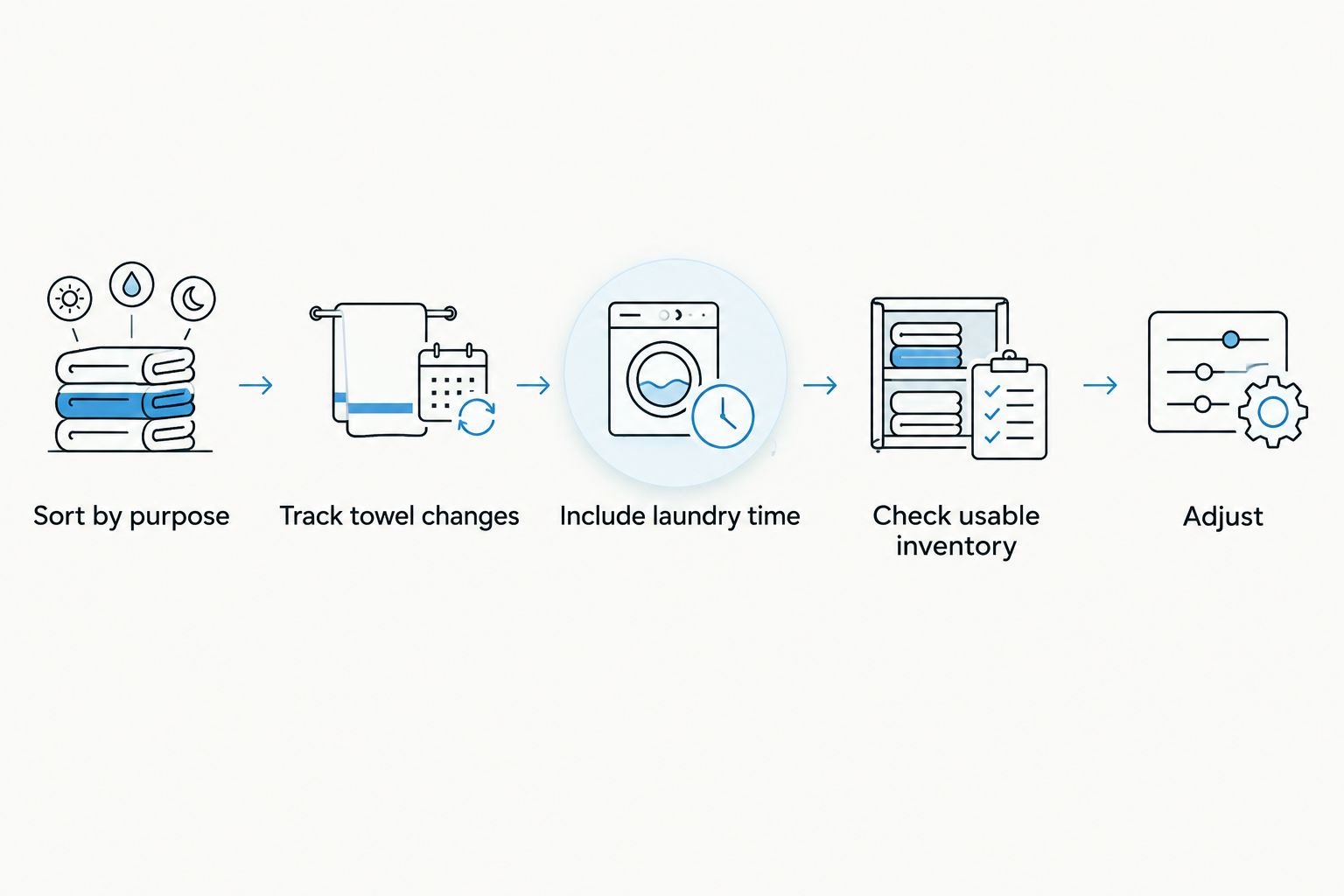
How to calculate your household's towel count
Follow your normal routine through a complete laundry cycle. Include washing, drying, and returning the clean towels to their storage spot—not just the moment you put a load in the machine.
1. Sort by purpose
Make separate groups for dish drying, hand drying, and cleanup. Keep display-only towels in their own group so they do not inflate your working inventory.
You do not need matching sets to make this distinction. A different color, pattern, or storage location can tell everyone which towel belongs to which task. Use a system your household will actually remember.
2. Track towel changes
Record each towel you take out of use before the next clean load returns to the kitchen. Count changes by task rather than counting how many towels happen to be hanging up at a particular moment.
Include changes caused by spills or food residue. Do not stretch a towel's use simply to make a smaller collection appear sufficient. The count should reflect your routine, not force your routine to fit a shopping target.
3. Include laundry time
Notice which clean towels you need while the used ones are washing and drying. Those replacements belong in your total because the kitchen does not stop operating when the laundry starts.
This is an easy detail to miss. A household can own enough towels to reach laundry day and still run out before that load is dry. Count the full turnaround rather than the wash alone.
4. Check usable inventory
Compare the towels your routine requires with the working towels you already own. Set aside display pieces and towels that no longer perform their assigned task.
Buy for the shortfall, not for an empty-looking drawer. If you have enough usable towels but cannot find a clean one, fix the storage or laundry handoff before adding more.
5. Adjust after a busy stretch
Check the system during the kind of cooking week you regularly have. Include packed lunches, baking, guests, or extra dishes when those activities are part of your normal life.
Do not build your everyday collection entirely around an unusual celebration. Keep occasional entertaining needs separate from the towels required for ordinary meals, then decide whether those extra towels deserve permanent drawer space.
Frequent laundry: count the full turnaround
A household that washes kitchen towels frequently can maintain a smaller rotation than the same household washing them less often. The benefit comes from returning clean towels to use sooner, not from keeping a used towel at the sink longer.
Best for: households with a dependable laundry routine. Keep clean replacements accessible, and check whether the routine still works when a load gets postponed. If every towel is already committed, your collection has no room for that delay.
For a 2026 declutter, remove surplus only after you confirm that the remaining working towels cover the full cycle. Reducing the drawer first and figuring out the routine afterward reverses the useful order.
Longer laundry intervals: count every towel change
When kitchen towels wait longer between loads, the working collection must cover more changes. The relevant number is how many towels leave service during that interval—not how many towels you wish could last until laundry day.
Best for: households that batch laundry. Store clean towels separately from used ones, and make the clean supply easy to check. The trade-off is space: the longer rotation needs somewhere to live without crowding out other kitchen tools.
If storage is tight, compare adding towels with shortening the laundry interval. Either change affects the rotation. Choose the one that fits your home instead of buying a larger collection you cannot comfortably store.
Why kitchen towel needs vary
Your household's towel count changes with the work the towels do and how quickly clean ones return. Use these factors to explain a shortage before deciding what to buy:
- Dish-drying workload: Hand-washed dishes require a different towel rotation from dishes left to air-dry or dried in a dishwasher.
- Hand-drying use: Count the clean hand towels your household actually uses, separately from towels assigned to dishes.
- Cooking and cleanup: Spills and food residue take towels out of service, even when your regular laundry day has not arrived.
- Laundry turnaround: Washing, drying, and putting towels away all affect when replacements become available.
- Usable condition: A drawer full of towels does not equal a drawer full of effective working towels.
- Storage space: Your collection needs a clean, accessible home; a larger pile is not automatically easier to manage.
Household size influences activity, but it does not describe all of it. Someone who cooks regularly and hand-washes dishes can have different needs from a larger household that uses its kitchen less often. Count tasks before assigning a towel allowance per person.
Choose replacements that fit the job
Once you know the shortfall, check material, dimensions, and care instructions before choosing a replacement. A printed design can make a towel easy to recognize, but it does not establish how quickly that individual towel dries or how it performs on glassware.
Betterhouse kitchen towels suit shoppers who want printed cotton towels for everyday routines. The options below illustrate different sizes and designs; neither needs to become your entire working collection.
| Towel | Verified material and dimensions | Best for | Useful distinction | Trade-off to check |
|---|---|---|---|---|
| Missy Elliott-Inspired Get Your Dry On Tea Kitchen Towel | 100% cotton flour sack; 21 inches by 28 inches | Shoppers who want a cotton flour-sack towel with a music-themed design | The material and dimensions are specified | Confirm care instructions and suitability for your intended task |
| Change Can Be Sunshine If You Let It In Kitchen Towel | Cotton; 18 inches by 28 inches | Shoppers who prefer a desert design and encouraging sentiment | Its listed width is narrower than the flour-sack option | Cotton alone does not establish linting or drying performance |
Use the dimensions to picture how the towel will hang and fold in your kitchen. The 21-inch width and 18-inch width give you a concrete fit comparison, while both towels have a listed 28-inch length. Size describes fit; it is not an absorbency ranking.


For Betterhouse purchases in 2026, use the stated 30-day return policy as a purchasing consideration, not as evidence of towel performance. Check the return terms before ordering, and keep product care decisions tied to the individual towel's instructions.
Do decorative kitchen towels count toward the total?
Decorative kitchen towels count only when you actually use them for the tasks included in your rotation. A towel reserved for display does not replace a clean dish-drying or hand-drying towel.
If you want both decoration and daily use, assign the towel a clear job. Otherwise, keep it outside the working stack so you can see whether your useful collection covers the laundry cycle.
Does a larger household always need more kitchen towels?
A larger household does not automatically need a fixed extra quantity of kitchen towels. Cooking activity, hand-drying use, dishwashing habits, and laundry turnaround determine the working total.
When reassessing your kitchen in 2026, count what leaves service rather than multiplying by the number of residents. That approach also helps when your household changes but your cooking routine stays similar.
Can you own too many kitchen towels?
You own more working kitchen towels than you need when usable towels remain outside the rotation and crowd the space required for everyday tasks. Keep occasional-use towels intentionally, rather than letting them disappear beneath the regular stack.
Before donating or repurposing extras, confirm that the remaining collection covers a complete laundry cycle. Surplus and a needed replacement are different things.
FAQ
How many kitchen towels does a household need in 2026?
A household needs enough working kitchen towels to cover towel changes between completed laundry loads, plus clean replacements during washing and drying. Count dish-drying and hand-drying needs separately rather than using a fixed allowance per person.
Should I use the same kitchen towel for hands and dishes?
Assign separate towels to hand drying and dish drying so each task has its own clean towel. Make the distinction clear through placement, color, or pattern.
Do I need more towels if I wash laundry less often?
A longer laundry interval requires enough towels to cover every change during that interval. Include the time needed to dry the load and return clean towels to the kitchen.
Do display towels count as kitchen towels I can use?
Display towels count toward your working total only if you actually use them. Keep display-only pieces separate when checking whether your clean supply is sufficient.
What's the best way to count the towels I already own?
Sort your towels by task and count only those that can still perform their assigned job. Compare that inventory with actual towel changes across a complete laundry cycle.
Are bigger kitchen towels always better?
A larger kitchen towel is not automatically better for every task. Compare dimensions with your hanging and storage space, then check material and care instructions separately.
Should I replace every towel when I buy new ones?
Replace the towels that no longer perform their assigned task or fill a demonstrated shortage. Keep usable towels in the rotation instead of replacing the whole collection simply to make it match.
One last thing
The most useful towel count is the count of clean towels you can actually find. Before adding to your collection, give the working stack a visible home and make returning washed towels part of finishing the load.
For your final 2026 check, look at the kitchen while a towel load is drying. If a suitable clean replacement is available for each active task, your rotation is doing its job. If not, identify the missing task before shopping.